Sony Brings AI Upscaling to PS5: QSSR Features, Supported Games and PSSR Comparison
Sony's Quick Spectral Super Resolution (QSSR) brings AI-powered image enhancement to the standard PlayStation 5. Learn how it works, which games support it, and how it compares with PS5 Pro's PSSR.
In this article
- What Is PS5 QSSR AI Upscaling?
- Why Sony Developed QSSR for the Standard PS5
- How Does QSSR Work on PlayStation 5?
- PS5 QSSR Supported Games
- Will More PS5 Games Support QSSR?
- QSSR vs PSSR: Key Differences Explained
- Does QSSR Improve PS5 Graphics?
- Does QSSR Increase FPS on PS5?
- How to Enable QSSR on PS5
- Is QSSR Available on PS5 Slim?
- Does QSSR Make PS5 Pro Unnecessary?
- Sony, AMD and Project Amethyst
- Why QSSR Matters for the Future of PlayStation
- Frequently Asked Questions
- Final Thoughts
- Sources and References
Sony is bringing artificial intelligence-powered graphics upscaling to the standard PlayStation 5 through a new technology called Quick Spectral Super Resolution (QSSR).
Announced on October 1, 2026, the technology is designed to improve image quality and visual stability in supported PS5 games without requiring players to upgrade to a PlayStation 5 Pro.
QSSR is a more efficient version of Sony's PlayStation Spectral Super Resolution (PSSR) technology, which was originally developed for PS5 Pro. By optimizing its neural network and processing requirements, Sony has made AI-assisted image reconstruction possible on the standard PS5 hardware.
The first games to support QSSR include Marvel's Wolverine and Ghost of Yōtei, with more developers expected to explore the technology in the future.
But what exactly is QSSR, how does it work, and can it make PS5 games look noticeably better?
Here is everything you need to know about Sony's latest AI graphics technology.
What Is PS5 QSSR AI Upscaling?
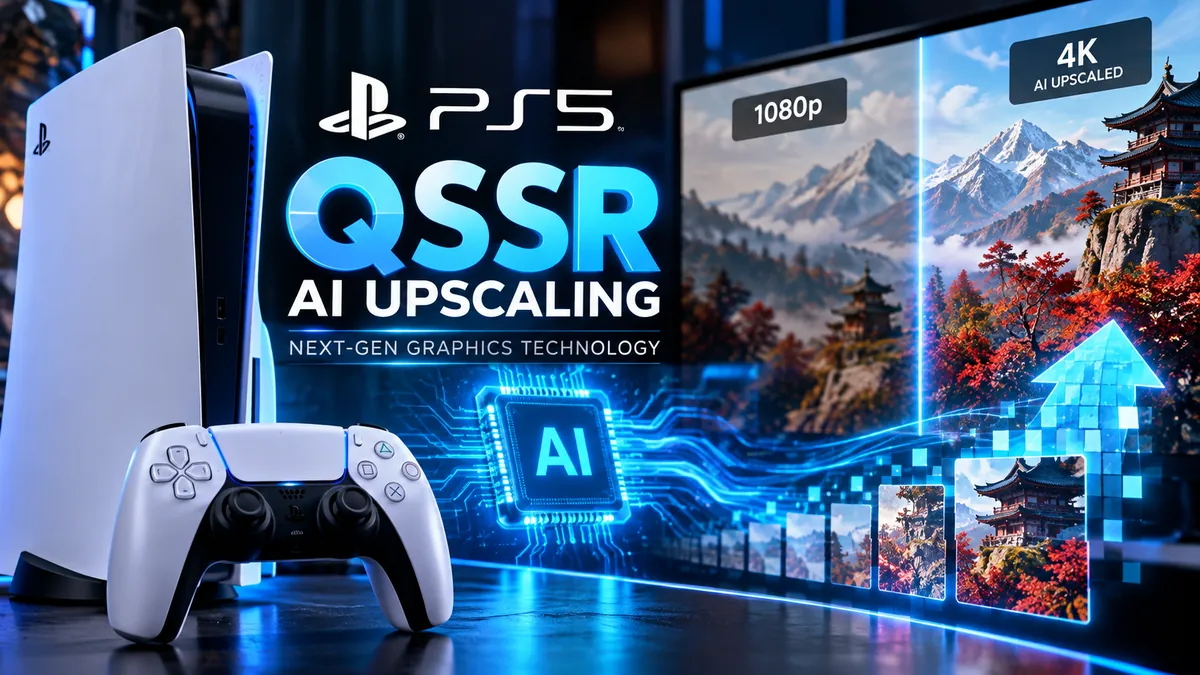
QSSR stands for Quick Spectral Super Resolution. It is Sony's AI-powered image reconstruction technology designed for the standard PlayStation 5.
In modern video games, rendering every frame at native 4K resolution can require substantial graphics processing power.
To balance image quality and performance, developers often render games at a lower internal resolution and then upscale the image to match a higher-resolution display.
Traditional upscaling techniques use mathematical algorithms to estimate additional pixel information.
AI upscaling takes a more advanced approach by using trained neural networks to reconstruct fine visual details.
Sony's QSSR is designed to make that process more efficient while maintaining image clarity and consistency.
The technology can help reduce visual artifacts such as shimmering, flickering, and unstable fine details.
For players, the result may be a sharper and more stable image in supported games.
However, actual improvements depend on how developers implement QSSR and how individual games are rendered.
Why Sony Developed QSSR for the Standard PS5
Sony introduced PlayStation Spectral Super Resolution as a major graphics feature for PS5 Pro.
PSSR uses machine learning to improve image reconstruction and is supported by the Pro console's specialized hardware capabilities.
The standard PS5 does not include the same dedicated processing resources.
As a result, the original PSSR implementation was not designed to run efficiently on the base console.
Sony needed a different approach to bring similar benefits to existing PS5 owners.
QSSR addresses this challenge through a streamlined neural network architecture and optimized processing techniques.
According to Sony, the new implementation reduces computational requirements while retaining many of the visual advantages associated with AI-based upscaling.
This allows supported games to benefit from improved image reconstruction without requiring new hardware.
For millions of existing PS5 owners, this is particularly important.
Instead of making AI graphics improvements exclusive to the latest console model, Sony is extending some of those capabilities to its established hardware.
How Does QSSR Work on PlayStation 5?
QSSR uses artificial intelligence to reconstruct a higher-resolution image from a lower-resolution rendering.
When a game runs, the graphics engine generates frames based on the available hardware resources and performance targets.
Producing every frame at the highest possible native resolution can reduce the resources available for other graphics features.
Upscaling allows developers to render at a more manageable resolution while displaying the result on a higher-resolution screen.
QSSR improves this process by applying an AI-based reconstruction model.
The model helps estimate image details that may not be fully represented in the original lower-resolution frame.
This can be especially useful for thin objects, complex textures, vegetation, distant scenery, and fine geometric details.
Another important objective is temporal stability.
In video games, images change continuously as characters move and cameras rotate.
An upscaling technique must maintain visual consistency from one frame to the next.
Poor reconstruction can produce shimmering edges, flickering textures, or unstable details.
QSSR is designed to reduce these problems while operating within the standard PS5's performance limitations.
Sony has not promised identical results across all games, so the quality of the final image will depend on each implementation.
PS5 QSSR Supported Games
Sony initially identified two major games supporting QSSR technology.
Marvel's Wolverine
Marvel's Wolverine, developed by Insomniac Games, is among the first titles to use QSSR on the standard PlayStation 5.
The technology is intended to improve image reconstruction in detailed environments and during fast-moving gameplay.
Modern action games contain complex lighting, textures, reflections, and environmental details.
Maintaining a stable image under these conditions can be challenging.
QSSR aims to preserve clarity and reduce distracting visual artifacts.
Early technical coverage has reported promising image-quality improvements, although the degree of improvement varies depending on the scene.
Ghost of Yōtei
Ghost of Yōtei, developed by Sucker Punch Productions, is another early QSSR-supported game.
The title features expansive environments, detailed landscapes, vegetation, and complex visual elements.
These types of scenes can benefit from more effective image reconstruction.
Sony says QSSR can improve the stability of fine details, helping the image remain more consistent during movement.
As with other graphics technologies, results depend on the game's rendering pipeline and graphics settings.
Players should ensure they have installed the latest compatible game updates.
Will More PS5 Games Support QSSR?
Sony plans to make QSSR available to more PlayStation developers.
This creates the possibility that additional games will adopt the technology through future updates or new releases.
However, QSSR is not automatically applied to every PS5 game.
Developers must integrate the technology into their rendering systems and evaluate its performance.
Some studios may decide to update existing games, while others may focus on future projects.
Sony has not published a complete list of all games that will eventually support QSSR.
For now, players should monitor official PlayStation announcements and individual game patch notes for confirmed compatibility.
QSSR vs PSSR: Key Differences Explained
QSSR and PSSR share the same general objective: improving image quality through AI-assisted reconstruction.
However, the technologies are designed for different PlayStation hardware capabilities.
PSSR, or PlayStation Spectral Super Resolution, is Sony's AI upscaling technology for PS5 Pro.
It benefits from the Pro console's specialized processing resources and more powerful graphics hardware.
QSSR, or Quick Spectral Super Resolution, is optimized for the standard PS5.
Its neural network and processing requirements have been adjusted to work within the base console's hardware limitations.
Both technologies aim to improve detail reconstruction and visual stability.
The main difference is the available computing power and the complexity of the implementation.
PS5 Pro remains the more capable graphics platform.
QSSR does not transform a standard PS5 into a PS5 Pro.
Instead, it brings a more efficient form of AI upscaling to existing PS5 hardware.
Does QSSR Improve PS5 Graphics?
QSSR is designed to improve the appearance of supported games.
Potential benefits include sharper fine details, reduced shimmering, more stable textures, and improved image reconstruction.
These improvements may be particularly noticeable in detailed environments.
For example, distant foliage, fences, architectural elements, and fine surface textures can be difficult for conventional upscaling methods to reproduce consistently.
AI reconstruction can help preserve these details.
However, players should not expect every game to look dramatically different.
Some games already use effective image reconstruction techniques, leaving less room for visible improvement.
Others may benefit more noticeably.
The final results depend on the game's resolution targets, rendering techniques, and implementation quality.
Does QSSR Increase FPS on PS5?
QSSR is primarily an image reconstruction technology rather than a universal frame-rate booster.
Its purpose is to help developers balance rendering performance and visual quality.
A game may use upscaling to achieve a desired resolution while reducing the cost of rendering every pixel natively.
However, the AI reconstruction process also requires computational resources.
That means QSSR does not automatically increase FPS in every supported game.
Performance may improve, remain similar, or involve trade-offs depending on the implementation.
Players should rely on actual performance testing rather than assuming AI upscaling always produces higher frame rates.
How to Enable QSSR on PS5
QSSR is a game-specific feature.
It is not a universal system setting that automatically improves every PlayStation 5 game.
To use QSSR, players need a game that officially supports the technology.
First, install the latest available update for the supported title.
Next, check the game's graphics or display settings.
If the developer provides a selectable QSSR option, it should appear in the relevant graphics menu.
Some games may integrate the technology automatically rather than offering a separate toggle.
The exact implementation depends on the developer.
If a game does not support QSSR, updating the console alone will not add the feature.
Players should consult official game documentation for the latest compatibility information.
Is QSSR Available on PS5 Slim?
Sony introduced QSSR for the standard PlayStation 5 platform.
The PS5 Slim belongs to the same general hardware performance class as the original PS5.
As a result, compatible software is expected to support the technology across standard PS5 models.
However, players should confirm specific compatibility through official game updates and Sony's documentation.
QSSR does not require purchasing a PS5 Pro.
It is designed to operate within the standard PS5 hardware environment.
Does QSSR Make PS5 Pro Unnecessary?
No.
The PS5 Pro still offers additional graphics capabilities and more powerful hardware.
Its PSSR technology is designed to take advantage of specialized processing resources.
QSSR brings a more efficient version of AI upscaling to the standard PS5, but it does not eliminate the hardware differences between the consoles.
For players who already own a PS5, QSSR may provide a meaningful visual improvement in supported games.
For those seeking the strongest PlayStation graphics performance, PS5 Pro continues to offer advantages.
The value of upgrading depends on the games being played, display capabilities, and personal performance expectations.
QSSR provides another reason for existing PS5 owners to evaluate software improvements before investing in new hardware.
Sony, AMD and Project Amethyst
Sony's AI graphics research is connected to Project Amethyst, its collaboration with AMD.
The initiative focuses on improving machine-learning techniques and graphics technology for gaming.
AI-based image reconstruction is one of the areas where this work can produce practical benefits.
Modern graphics systems increasingly combine traditional rendering with advanced reconstruction methods.
This allows developers to allocate computing resources more efficiently.
Instead of rendering every visual detail at the highest native resolution, a game can use intelligent reconstruction to produce a high-quality final image.
Similar ideas are used across the industry in technologies such as NVIDIA DLSS and AMD FidelityFX Super Resolution.
However, the underlying implementations and hardware requirements differ.
Sony's QSSR represents its own approach to bringing these capabilities to the standard PS5.
Why QSSR Matters for the Future of PlayStation
The introduction of QSSR highlights an important trend in gaming technology.
Graphics improvements are no longer determined exclusively by new hardware.
Software optimization and artificial intelligence are becoming increasingly important.
AI upscaling can help developers improve perceived image quality while working within existing hardware limitations.
This is especially valuable for consoles, where hardware configurations remain relatively consistent for several years.
Technologies such as QSSR may help extend the useful life of existing systems.
They also provide developers with new tools for balancing image quality, performance, and visual effects.
However, AI reconstruction is not a replacement for every aspect of graphics processing.
Rendering performance, memory bandwidth, lighting systems, and game engine optimization remain essential.
The most effective results come from combining strong hardware with carefully designed software.
Frequently Asked Questions
What is QSSR on PS5?
QSSR stands for Quick Spectral Super Resolution. It is Sony's AI-powered image upscaling technology designed for the standard PlayStation 5.
Is QSSR available on the original PS5?
Yes. Sony announced QSSR for the standard PS5 platform, with initial support in selected games.
Which games support PS5 QSSR?
The first announced supported titles include Marvel's Wolverine and Ghost of Yōtei. Additional games may adopt the technology in the future.
Is QSSR better than PSSR?
PSSR is Sony's higher-end AI upscaling technology for PS5 Pro. QSSR is a more efficient implementation optimized for the standard PS5.
Does QSSR improve FPS?
Not necessarily. QSSR focuses on image reconstruction, and performance results depend on how each game uses the technology.
Do I need a PS5 Pro for QSSR?
No. QSSR is specifically designed to bring AI-assisted upscaling to standard PS5 hardware.
Will all PS5 games support QSSR?
No. Developers must integrate QSSR into individual games. Sony has not announced universal support across the entire PS5 library.
Can QSSR improve 4K gaming?
QSSR is designed to improve the reconstruction of higher-resolution images, including output for 4K displays, but actual results depend on the game.
Final Thoughts
Sony's Quick Spectral Super Resolution represents an important development in AI-assisted gaming graphics.
By bringing a more efficient version of its PSSR technology to the standard PS5, Sony is expanding access to advanced image reconstruction without requiring a console upgrade.
Initial support in Marvel's Wolverine and Ghost of Yōtei demonstrates how the technology can be integrated into existing PlayStation hardware.
The broader impact will depend on how many developers adopt QSSR and how effectively they use it.
For PS5 owners, the technology offers the potential for sharper visuals and improved image stability in supported games.
For the gaming industry, it is another example of how artificial intelligence is becoming an increasingly important part of modern graphics technology.
Sources and References
- Sony PlayStation Blog — AI Upscaling Is Coming to PS5 (October 1, 2026)https://blog.playstation.com/?p=424016
- The Verge — Sony Brings AI Graphics Upscaling to the Regular PS5 https://www.theverge.com/games/1003549/sony-ps5-quick-spectral-super-resolution-qssr
- TechRadar — Sony Reveals QSSR Upscaling for the Base PS5 https://www.techradar.com/gaming/sony-has-revealed-its-new-qssr-upscaling-tech-for-the-base-ps5-with-tech-analysts-confirming-an-exceptional-quality-boost-for-marvels-wolverine-while-ghost-of-yotei-saw-less-dramatic-improvements
- Editorial Note: This article reflects information available as of October 16, 2026. Game compatibility, technical performance, and future support may change through software updates.