Google TorchTPU Goes Open Source: What It Means for PyTorch and NVIDIA
Google has released TorchTPU as open source, making it easier to run familiar PyTorch workloads on Google TPUs. Here's how the technology works, what it means for AI developers, and why it could reshape hardware competition.
In this article
- What Is Google TorchTPU?
- What Google Announced on October 20, 2026
- Why Native PyTorch Support Matters
- TorchTPU and NVIDIA: Is Google Challenging CUDA?
- How TorchTPU Supports AI Model Training
- What About Running AI Models in Production?
- Google TPU vs. NVIDIA GPU: What Developers Should Compare
- Is TorchTPU Completely New?
- What TorchTPU Does Not Guarantee
- Why This Matters Beyond Google and NVIDIA
- What Developers Should Do Next
- Frequently Asked Questions
- Final Thoughts
- Sources and Further Reading
Google has taken a significant step toward making its custom AI chips more accessible to developers. On October 20, 2026, the company announced that TorchTPU, its native PyTorch software stack for Tensor Processing Units (TPUs), is available as open source.
The announcement matters because PyTorch is one of the most widely used frameworks for developing artificial intelligence models. For many teams, the choice of AI hardware is influenced not only by computing power but also by how easily their existing software runs on it.
TorchTPU aims to reduce that barrier. Instead of asking developers to redesign their workflows around a different programming environment, Google wants them to use familiar PyTorch tools while taking advantage of its TPU infrastructure.
The move also raises an important question for the AI industry: could easier software compatibility make Google's custom chips a more practical alternative to NVIDIA GPUs?
The answer is promising but not straightforward. TorchTPU expands the options available to developers, yet hardware performance, operating costs, software maturity, and real-world reliability will still determine which platform works best for a particular project.
What Is Google TorchTPU?
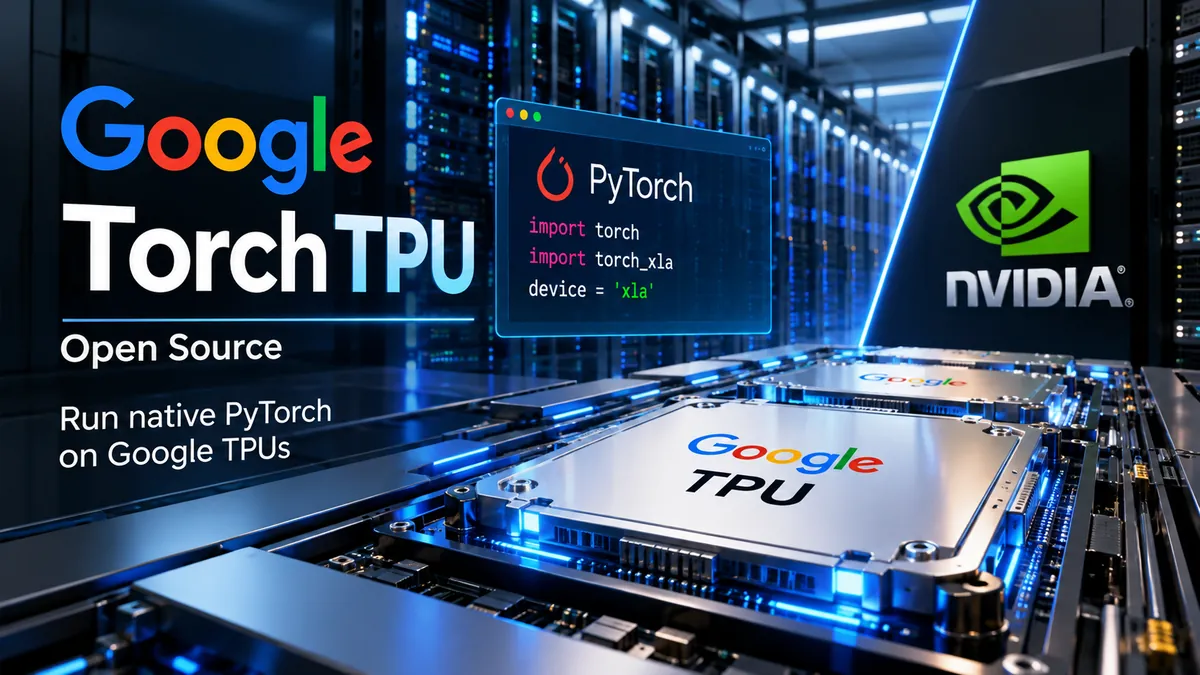
TorchTPU is an open-source software stack that enables developers to run PyTorch workloads natively on Google's Tensor Processing Units.
TPUs are specialized processors designed by Google to accelerate machine learning operations. They have been used across Google's AI infrastructure and are also available to customers through Google Cloud.
PyTorch, meanwhile, is a machine learning framework widely used for building, training, and deploying neural networks. Its popularity comes partly from its flexible programming model and large ecosystem of libraries, research projects, and developer tools.
Historically, using PyTorch with TPUs could require developers to work with additional integration layers or adjust parts of their code and workflows. Google previously supported PyTorch through PyTorch/XLA, an established route for running PyTorch programs on TPU hardware.
TorchTPU represents a newer approach. It is designed to make TPUs feel more like a native PyTorch computing device, reducing the differences developers encounter when moving between supported hardware platforms.
Google says the software was co-developed with the PyTorch team at Meta and is intended to support familiar PyTorch APIs.
That distinction is important: TorchTPU is not a new AI model, chatbot, or consumer application. It is infrastructure software for people and organizations developing AI systems.
What Google Announced on October 20, 2026
At PyTorch Conference 2026, Google announced that TorchTPU had become publicly available as an open-source project.
The company positioned the release as part of a broader effort to give PyTorch developers more choices across CPUs, GPUs, and TPUs.
Google also highlighted integrations with several established AI tools and frameworks, including vLLM, SGLang, TorchTitan, Hugging Face, Ray, TorchRec, and llm-d.
These integrations matter because building an AI model is only one part of a production system. Teams also need tools for training large models, distributing work across multiple processors, serving responses to users, and managing infrastructure.
A hardware platform becomes much more attractive when developers can reuse the software they already know.
The open-source release also allows developers to inspect the available code, participate in its development, and evaluate the technology without relying entirely on closed software interfaces.
However, open-source availability should not be confused with free access to TPU hardware. Running workloads on commercial cloud infrastructure can still involve computing, storage, and networking charges.
How TorchTPU Works
Modern AI workloads rely on large numbers of mathematical operations. Accelerators such as GPUs and TPUs execute these operations much more efficiently than general-purpose processors for many machine learning tasks.
The challenge is that different accelerators have different architectures, execution methods, and software interfaces.
PyTorch gives developers a common framework for describing models and calculations. A backend then helps translate the framework's operations into instructions that the selected hardware can execute.
TorchTPU provides a native PyTorch path to Google's TPU hardware.
According to Google's developer documentation, the new backend supports familiar PyTorch programming patterns and introduces TPU support through the standard device interface.
For developers, the practical goal is to make moving an eligible workload to TPU infrastructure less disruptive.
Consider a research team that has already developed a model in PyTorch. Previously, exploring another accelerator could involve additional compatibility work, testing, and changes to the execution environment.
With TorchTPU, the team may be able to preserve more of its existing code and development workflow while testing the model on Google TPUs.
That does not mean every PyTorch project will run without modifications. Individual operations, third-party extensions, custom kernels, distributed configurations, and performance requirements can still create compatibility challenges.
Developers should test their specific workloads rather than assume that a successful installation guarantees production readiness.
Why Native PyTorch Support Matters
Software compatibility is a major factor in AI infrastructure decisions.
An organization may have invested years in PyTorch-based model development, training pipelines, monitoring systems, and engineering expertise. Moving to unfamiliar infrastructure can introduce costs beyond the price of the hardware itself.
Those costs can include rewriting code, retraining staff, rebuilding deployment pipelines, and diagnosing unexpected performance differences.
By improving PyTorch compatibility, Google is attempting to reduce some of that friction.
The benefits could be especially relevant in three situations.
First, research teams may find it easier to experiment with TPU hardware without rebuilding their entire development environment.
Second, companies operating large AI services may gain another infrastructure option when planning capacity and managing costs.
Third, developers using established open-source frameworks may benefit from wider hardware support across the tools they already use.
The broader effect could be increased competition between accelerator platforms, although the size of that effect remains uncertain.
TorchTPU and NVIDIA: Is Google Challenging CUDA?
NVIDIA occupies a central position in AI computing, and its software ecosystem is one reason why.
CUDA, NVIDIA's parallel computing platform, has helped developers build and optimize software for NVIDIA GPUs over many years.
For AI teams, CUDA is more than a technical feature. It is part of a mature environment of libraries, optimization tools, documentation, and engineering practices.
That ecosystem can make NVIDIA hardware a convenient choice even when other processors are available.
Google's TorchTPU strategy addresses part of this challenge from a different direction.
Rather than requiring developers to abandon PyTorch, Google is working to make its own accelerator compatible with the framework many teams already use.
This could make TPUs easier to evaluate alongside NVIDIA GPUs.
But TorchTPU does not replace CUDA, and its release does not establish that Google TPUs outperform NVIDIA hardware.
The two platforms differ in architecture, software capabilities, availability, and workload-specific behavior.
A company training a large language model might reach a different conclusion from a company serving smaller models to customers. Even two models of similar size can have different performance characteristics.
A meaningful comparison requires testing the actual application under comparable conditions.
That includes measuring throughput, latency, utilization, operational complexity, and total cost.
The most important result of TorchTPU may therefore be increased choice rather than an immediate change in which company leads the AI chip market.
How TorchTPU Supports AI Model Training
Training is the process of adjusting a model's parameters using data and mathematical optimization.
Large training jobs often run across many accelerator chips. Engineers must coordinate the distribution of data, model parameters, memory, and calculations.
Google's TorchTPU initiative includes integration with TorchTitan, an open-source platform designed for large-scale model training using PyTorch.
In a separate October 20 technical announcement, Google described work on bringing TorchTPU into TorchTitan and optimizing training workflows for TPU infrastructure.
This is relevant to developers working on large language models and other computationally demanding AI systems.
The integration is intended to help teams use familiar PyTorch training techniques while taking advantage of TPU-specific capabilities.
Nevertheless, scaling a model across many accelerators remains a complex engineering task.
Efficient training depends on more than a compatible software interface. Teams also need effective communication between processors, memory management, stable execution, and carefully optimized operations.
TorchTPU may simplify parts of the development experience, but it does not eliminate the technical challenges of large-scale training.
What About Running AI Models in Production?
Training receives substantial attention, but inference is equally important to the economics of AI.
Inference occurs when a trained model processes a request and produces an output. Every response from an AI assistant, for example, requires computing resources.
Companies serving AI applications must balance response speed, capacity, reliability, and cost.
Alongside the TorchTPU release, Google announced native PyTorch backends for vLLM and SGLang on TPU infrastructure.
These tools are used in systems that serve large language models and related AI workloads.
The new integrations are intended to make it easier for developers to bring supported PyTorch models to Google TPUs while continuing to use familiar serving tools.
For an AI application provider, this could create another option for deploying models at scale.
The potential benefits include greater infrastructure flexibility and more opportunities to optimize costs for specific workloads.
Actual results will depend on model architecture, hardware configuration, traffic patterns, and the maturity of the software integration.
Developers should evaluate performance with representative workloads before making deployment decisions.
Google TPU vs. NVIDIA GPU: What Developers Should Compare
It is tempting to frame the AI chip market as a simple contest between two processors. In practice, the better choice depends on the application.
Software compatibility
NVIDIA GPUs benefit from an extensive software ecosystem. TorchTPU improves Google's position by offering a more familiar PyTorch development experience on TPUs.
Performance
Training speed and inference throughput depend on the model, numerical precision, batch size, memory requirements, and distributed setup. A benchmark from one workload cannot reliably predict every other workload.
Cost
Cloud pricing is only part of the calculation. Engineering time, hardware utilization, data movement, and operational overhead can affect the total cost of running an AI service.
Availability
Organizations must consider whether suitable hardware capacity is available in the regions and configurations they need.
Reliability and support
Production teams need stable software, clear documentation, monitoring, and a practical way to resolve problems when systems fail.
Flexibility
Some organizations may prefer to avoid depending on a single accelerator vendor. Improved PyTorch portability can make a multi-platform strategy more realistic.
For developers evaluating TorchTPU, the sensible approach is to begin with a representative model and compare results against their current environment.
A controlled pilot can reveal whether the potential benefits justify migration or additional infrastructure complexity.
Is TorchTPU Completely New?
Not entirely.
Google has supported PyTorch on Cloud TPUs for years, including through PyTorch/XLA.
The company also discussed native PyTorch support for TPUs earlier in 2026.
What changed on October 20 was the public open-source release of TorchTPU and the accompanying expansion of integrations.
This distinction matters because describing TorchTPU as the first time PyTorch has ever worked on Google TPUs would be inaccurate.
The more meaningful development is Google's effort to make the experience more native, accessible, and compatible with commonly used PyTorch tools.
What TorchTPU Does Not Guarantee
Several limitations are worth understanding before interpreting the announcement as a breakthrough for every AI developer.
TorchTPU does not guarantee that every PyTorch model or extension will work unchanged.
It does not prove that Google TPUs are faster than NVIDIA GPUs in all situations.
It does not make commercial TPU computing resources free.
It does not automatically reduce the cost of running every AI application.
And it does not mean organizations can switch accelerator platforms without testing, optimization, or operational planning.
These distinctions are especially important for businesses considering major infrastructure investments.
An open-source release can accelerate adoption and community development, but its long-term impact depends on how well the software performs in real deployments.
Why This Matters Beyond Google and NVIDIA
The AI industry's hardware competition increasingly involves software as well as chips.
Developers want access to powerful computing resources, but they also want familiar programming tools and the ability to move workloads without excessive effort.
When hardware platforms support widely adopted frameworks, organizations gain more room to experiment.
That could encourage greater competition in cloud AI services and reduce some of the practical barriers to evaluating alternative accelerators.
The timing is also notable.
Amazon has been pursuing a similar goal with TorchNeuron, an initiative designed to bring native PyTorch support to its Trainium AI chips.
Although TorchTPU and TorchNeuron target different hardware, both reflect the same industry trend: custom AI accelerator providers are working to make their systems easier for PyTorch developers to use.
This does not guarantee that either platform will take substantial market share from NVIDIA. It does suggest that developer experience is becoming an increasingly important competitive factor.
What Developers Should Do Next
Developers interested in TorchTPU should begin with Google's official documentation and open-source resources.
The first step is to identify a PyTorch workload that represents their actual needs. A small demonstration may confirm basic compatibility, but it is not enough to estimate production performance.
Next, teams should review the supported software environment and determine whether the model depends on custom operations or third-party components.
A practical evaluation should measure training or inference performance, memory use, stability, and total operating cost.
It should also include the engineering effort required to move the workload.
For organizations already committed to NVIDIA infrastructure, TorchTPU may be worth monitoring without requiring an immediate migration.
For teams exploring new AI deployments, it offers another platform to consider.
Frequently Asked Questions
What is Google TorchTPU?
TorchTPU is an open-source software stack that enables native PyTorch workloads on Google's Tensor Processing Units. It is designed to make TPU hardware easier to use with familiar machine learning tools.
When did Google open-source TorchTPU?
Google announced the open-source release on October 20, 2026, during PyTorch Conference 2026.
Is TorchTPU an AI model?
No. TorchTPU is infrastructure software for running AI workloads on TPU hardware. It is not a chatbot or a standalone generative AI model.
Can existing PyTorch models run on Google TPUs?
Many supported workloads may require fewer changes with TorchTPU, but compatibility depends on the model, operations, libraries, and configuration. Developers should test individual projects.
Is TorchTPU free?
The software is open source. However, using TPU hardware through cloud services may involve infrastructure charges.
Does TorchTPU make Google TPUs better than NVIDIA GPUs?
Not automatically. TorchTPU improves software accessibility, but performance and cost advantages must be evaluated for each workload.
Can TorchTPU be used for AI inference?
Yes. Google has announced integrations with serving tools including vLLM and SGLang to support inference workloads on TPUs.
Final Thoughts
Google's decision to open-source TorchTPU is an important development in AI infrastructure because it addresses a practical obstacle to hardware competition: software compatibility.
By making TPUs more accessible to PyTorch developers, Google is attempting to lower the effort required to evaluate and use its custom processors.
The announcement is not proof that NVIDIA's position has been overturned, nor does it guarantee lower costs or faster performance for every AI workload.
Its immediate significance is more concrete. Developers now have another open-source route for using familiar PyTorch tools with Google TPU infrastructure.
If the ecosystem continues to mature, TorchTPU could help make AI hardware choices more flexible for researchers, startups, and enterprises.
Sources and Further Reading
- Google Cloud — TorchTPU Is Now Open Source, October 20, 2026 https://cloud.google.com/blog/topics/ai-infrastructure/torchtpu-is-now-open-source-run-native-pytorch-on-tpus
- Google Cloud Documentation — PyTorch on Cloud TPU https://docs.cloud.google.com/tpu/docs/pytorch-on-tpu
- Google Developers Blog — Integrating TorchTPU Into TorchTitan, October 20, 2026 https://developers.googleblog.com/integrating-torchtpu-into-torchtitan-and-optimizing-models-for-tpu/
- Google Developers Blog — New vLLM and SGLang Inference Engines on TPU, October 20, 2026 https://developers.googleblog.com/announcing-new-vllm-and-sglang-inference-engines-on-tpu/
- vLLM Project — Introducing vLLM TorchTPU, October 20, 2026 https://vllm-project.github.io/2026/10/20/vllm-torchtpu.html