Claude Opus 5.5 vs Claude Fable 5.1: Which Claude Model Should You Use?
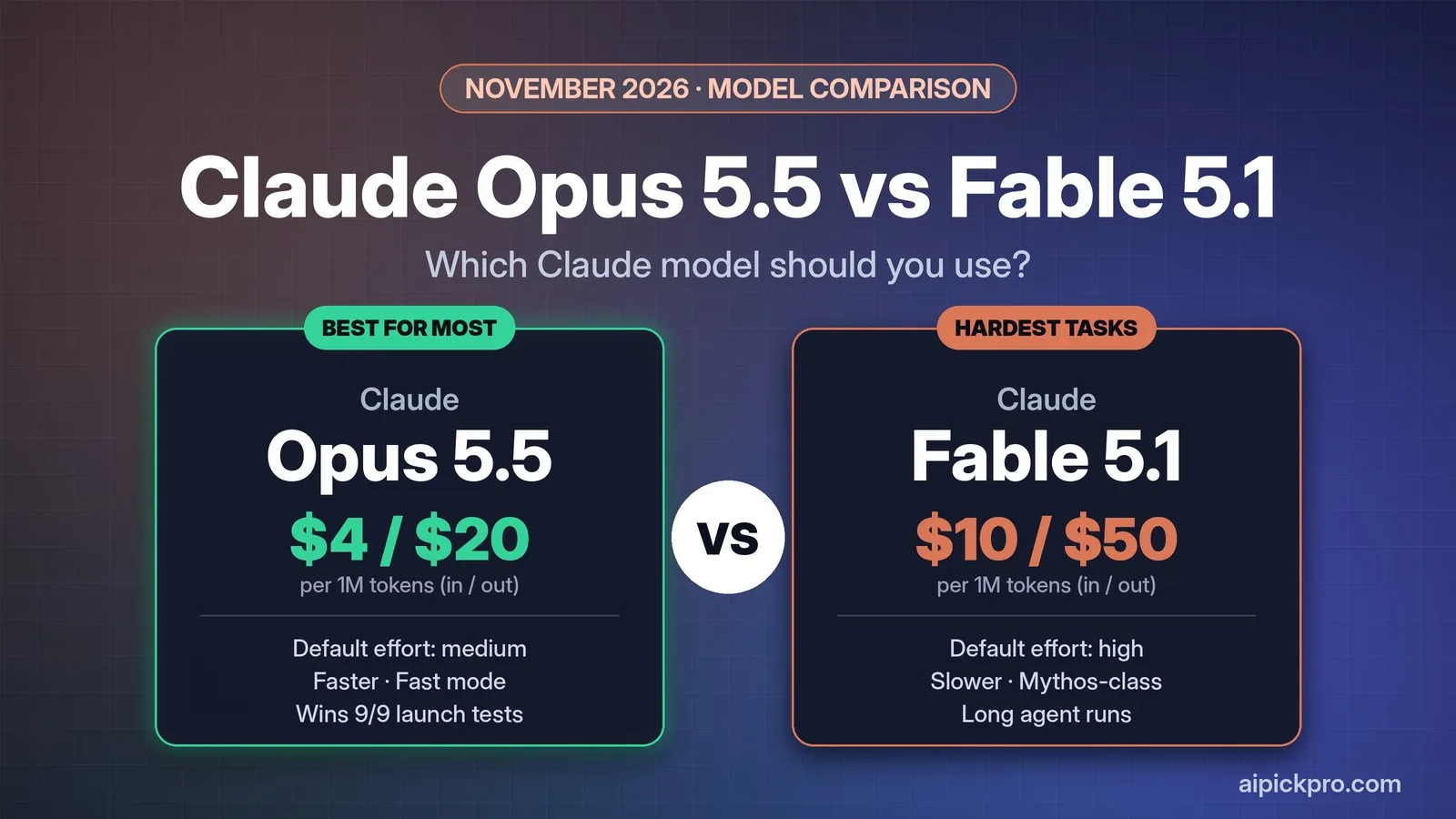
Claude Opus 5.5 costs 60% less than Fable 5.1 and beat it on every launch benchmark. Here is how the two Claude models compare on price, speed, plans and safety, and when Fable 5.1 is still worth it.
In this article
- Claude Opus 5.5 vs Fable 5.1 at a glance
- What is Claude Fable 5.1?
- What is Claude Opus 5.5?
- Benchmarks: Opus 5.5 wins every published test
- Price: Fable 5.1 costs 2.5 times as much
- Speed and real-world tasks
- Which model do you get on Claude Pro and Max?
- Safety rules: an important difference for security work
- What about Claude Sonnet 5.5?
- Which one should you choose?
- The bottom line
- Frequently asked questions
- Sources
Quick answer: For most people, Claude Opus 5.5 is the better choice. It costs 60% less per token than Claude Fable 5.1, runs faster and scored higher on every benchmark Anthropic published when it launched. Fable 5.1 is worth paying for only when Opus 5.5 at high effort still can't finish a very long or very difficult task, which is also how Anthropic itself positions the two models.
Anthropic released Claude Fable 5.1 on September 1, 2026 as its most capable generally available model. Three weeks later, on September 22, it launched Claude Opus 5.5 and said the cheaper model performs at Fable 5.1's level on most work. That leaves many developers and subscribers with an awkward question: if the cheaper model is just as good, when does the expensive one still make sense?
This guide compares the two models on price, benchmarks, speed, subscription access and safety rules, and ends with a simple rule for choosing. If you are also weighing Google and OpenAI models, see our Gemini 4 Carbon vs Claude Opus 5.5 vs GPT-6 Astra comparison.
Claude Opus 5.5 vs Fable 5.1 at a glance
| Claude Opus 5.5 | Claude Fable 5.1 | |
|---|---|---|
| Released | September 22, 2026 | September 1, 2026 |
| API model ID | claude-opus-5-5 | claude-fable-5-1 |
| Anthropic's positioning | Default choice for most work | Demanding reasoning and long-horizon agent work |
| API price (input / output per 1M tokens) | $4 / $20 | $10 / $50 |
| Context window | 1M tokens | 1M tokens |
| Maximum output | 128K tokens | 128K tokens |
| Default effort (API) | Medium | High |
| Speed (Anthropic's label) | Moderate | Slower |
| Fast mode | Yes ($8 / $40) | No |
| Knowledge cutoff | June 2026 | June 2026 |
On paper the two models look almost identical: the same context window, the same output limit, the same training cutoff and always-on adaptive thinking. The real differences are price, speed and where each model is allowed to go on sensitive tasks.
What is Claude Fable 5.1?
Fable 5.1 is Anthropic's Mythos-class model released to the general public. It replaced Fable 5, which first launched in June 2026, at the same input and output price, while cutting the cost of cached input to a quarter of its previous level. Anthropic describes it as the model for demanding reasoning and long-running agent tasks, such as multi-day coding projects or research that runs over many steps.
Fable 5.1 has a sibling, Claude Mythos 5.1. According to Anthropic's documentation, the two share the same specifications and pricing, but Mythos 5.1 is only available to organizations verified through Anthropic's trusted-access programs, such as its Cyber Verification Program. For everyone else, Fable 5.1 is the top of the Claude lineup.
What is Claude Opus 5.5?
Opus 5.5 is the first model in Anthropic's Claude 5.5 family and the successor to Opus 5. Anthropic says it needs less computing power to serve than Opus 5, so its prices dropped: $4 per million input tokens and $20 per million output tokens, down from $5 and $25. The company also says that, at default settings, Opus 5.5 costs about 40% less than Opus 5 on typical workloads and writes its answers more than 30% faster.
Opus 5.5 was followed by Claude Sonnet 5.5 and Claude Haiku 5.5, which are cheaper still. We explain where they fit below.
Benchmarks: Opus 5.5 wins every published test
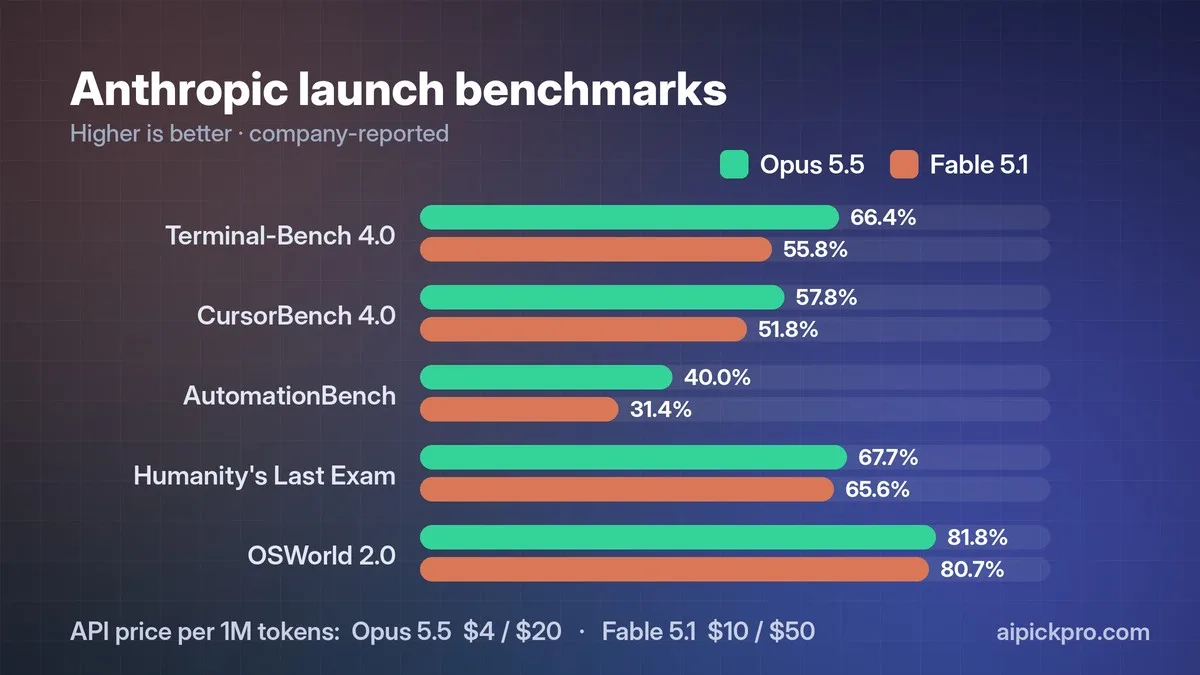
In its Opus 5.5 launch post, Anthropic published nine benchmarks comparing the new model with Fable 5.1. Opus 5.5 scored higher on all nine:
| Benchmark (Anthropic-reported) | Opus 5.5 | Fable 5.1 | Gap |
|---|---|---|---|
| Terminal-Bench 4.0 (agentic coding) | 66.4% | 55.8% | +10.6 |
| CursorBench 4.0 (agentic coding) | 57.8% | 51.8% | +6.0 |
| FrontierCode v1.1 (agentic coding) | 54.4% | 50.3% | +4.1 |
| AutomationBench (business workflows) | 40.0% | 31.4% | +8.6 |
| GDPval-AA v2.1 (knowledge work, Elo) | 1846 | 1735 | +111 |
| Terminal-Bench-Science 0.1 | 58.7% | 52.6% | +6.1 |
| Humanity's Last Exam (with tools) | 67.7% | 65.6% | +2.1 |
| OSWorld 2.0 (computer use) | 81.8% | 80.7% | +1.1 |
| Chartography (visual reasoning) | 89.0% | 88.4% | +0.6 |
Two details matter when reading this table. First, these are company-reported results, and Opus 5.5 was run at its highest effort settings on most tests. Second, several gaps are small: on computer use, visual reasoning and Humanity's Last Exam the difference is about two points or less, which is close to normal test-to-test variation. Anthropic itself says the real-world gap between the two models is narrower than the scores suggest.
The clearest lead for Opus 5.5 is agentic coding in a terminal, where it is more than ten points ahead. If you mainly use Claude for coding, our guide to the best AI coding assistants in November 2026 compares Claude Code with Codex, Cursor and GitHub Copilot.
Price: Fable 5.1 costs 2.5 times as much
Through the Claude API, every price line favors Opus 5.5:
| Price per 1M tokens | Opus 5.5 | Fable 5.1 |
|---|---|---|
| Input | $4 | $10 |
| Output | $20 | $50 |
| Cache write (5 minutes) | $5 | $12.50 |
| Cache read | $0.20 | $0.25 |
| Batch input / output | $2 / $10 | $5 / $25 |
A simple example: a job that would cost $100 on Fable 5.1 at list prices costs $40 on Opus 5.5, before counting any difference in how many tokens each model uses. Independent testing points the same way. On Artificial Analysis's index, Opus 5.5 at its default medium effort and Fable 5.1 at its default high effort reached the same score, but the Opus run cost about $1.34 per task compared with about $3.91 for Fable.
The one place Fable 5.1 is relatively cheap is cache reads. At $0.25 per million tokens, re-reading a large cached codebase or document costs only slightly more than on Opus 5.5, which helps in very long agent sessions.
Speed and real-world tasks
Anthropic labels Opus 5.5 "moderate" and Fable 5.1 "slower". Artificial Analysis measured about 78 output tokens per second for Opus 5.5 at medium effort and about 56 for Fable 5.1 at high effort. Opus 5.5 also offers a fast mode at double the standard price, which Fable 5.1 does not.
Anthropic shared one practical comparison: both models were asked to rewrite the HAProxy load balancer from C into Rust. Both versions passed nearly all of HAProxy's own regression tests, but Opus 5.5 finished in about 9.5 hours instead of 12 and cost 51% less. Like the benchmarks, this is a company-reported result, but it shows the pattern well: similar quality, lower cost, less waiting.
Which model do you get on Claude Pro and Max?
If you use Claude through a subscription instead of the API, the difference is even bigger:
- Free plan: neither model. Free users get Sonnet and Haiku.
- Pro: Opus models are part of your plan. Fable 5.1 is not included in your usage limits and runs on paid usage credits from the first message.
- Max: Fable 5.1 is included for up to 50% of your weekly usage limits, and it uses those limits faster than other models. After that, you pay with usage credits or switch models.
- Team and Enterprise: premium seats work like Max, while standard seats use usage credits for Fable.
For a typical Pro subscriber, that makes Opus 5.5 the practical default. Fable 5.1 is an extra cost you choose only for specific jobs. If you are comparing AI subscriptions in general, our guide to ChatGPT's Free, Go, Plus and Pro plans shows how OpenAI structures its tiers.
Safety rules: an important difference for security work
Both models run with safeguards around biology and cybersecurity, but they handle security tasks differently. Fable 5.1 can help with defensive vulnerability research but not with building exploits. With Opus 5.5, you can find and fix bugs in your own code, but many other cybersecurity requests are handled by the older Opus 4.8 instead. Anthropic says it will expand its Cyber Verification Program to cover Opus 5.5.
For most writing, coding and research, you will not notice this. If your work involves security testing, check Anthropic's current rules before choosing a model.
What about Claude Sonnet 5.5?
For everyday and high-volume work, you may not need either model. Claude Sonnet 5.5 costs $2 per million input tokens and $10 per million output tokens, half the price of Opus 5.5, and Anthropic labels it fast. It is a sensible default for chat apps, content tasks, customer support and routine coding, with Opus 5.5 kept for harder problems.
Which one should you choose?
- You want one model for most work: choose Opus 5.5. It is cheaper, faster and at least as strong on the published tests.
- You run large volumes of simple tasks: start with Sonnet 5.5 and move up only where quality falls short.
- Opus 5.5 at high effort still fails your hardest task: try Fable 5.1. Very long agent runs and the most demanding reasoning are the cases Anthropic built it for.
- You are on Claude Pro: stay with Opus 5.5 unless a specific job is worth paying usage credits for.
- You are on Claude Max: use Opus 5.5 day to day and save your Fable allowance for the few tasks that need it.
The best test is your own work. Run the same task, with the same files and instructions, on both models and compare quality, time and total cost. Anthropic's own advice follows the same logic: start with Opus and move to Fable only when your results show you need it.
The bottom line
Claude Opus 5.5 has made Fable 5.1 a specialist tool rather than the default choice. It matches or beats Fable on Anthropic's published benchmarks, costs 60% less per token, responds faster and is easier to use on a Pro subscription. Fable 5.1 still has a place for the longest and hardest agent tasks, but for most developers, businesses and subscribers, Opus 5.5 is the model to start with.
Frequently asked questions
Is Claude Opus 5.5 better than Claude Fable 5.1?
On the nine benchmarks Anthropic published at launch, yes: Opus 5.5 scored higher on all of them. Some gaps are small, and Anthropic says the real-world difference is narrower than the scores suggest, so Fable 5.1 can still be better on some very long or difficult tasks.
How much cheaper is Opus 5.5 than Fable 5.1?
Opus 5.5 costs $4 per million input tokens and $20 per million output tokens, compared with $10 and $50 for Fable 5.1. That is 60% less on both input and output.
Is Claude Fable 5.1 included in Claude Pro?
No. Fable 5.1 is available to Pro subscribers, but it runs on paid usage credits rather than the plan's normal limits. Max plans include it for up to 50% of the weekly usage limit.
What is the difference between Claude Fable 5.1 and Claude Mythos 5.1?
They share the same capabilities, specifications and pricing. Mythos 5.1 has more permissive safeguards and is only available to organizations verified through Anthropic's trusted-access programs, while Fable 5.1 is available to everyone.
Do both models have a 1 million token context window?
Yes. Both support a 1M-token context window and up to 128K output tokens, with a June 2026 knowledge cutoff.