Microsoft MAI-Base-2 AI: Can It Challenge OpenAI With Less Computing Power?
Microsoft's MAI-Base-2 AI model signals a new step in its AI strategy. Explore the company's performance claims, computing efficiency, and implications for OpenAI and Copilot.
In this article
- What Is Microsoft MAI-Base-2?
- How Much Computing Power Did Microsoft Use?
- Did Microsoft Really Beat OpenAI With 75% Less Compute?
- MAI-Base-2 vs. OpenAI: What Is the Difference?
- Why Microsoft's Mixture-of-Experts Architecture Matters
- Could MAI-Base-2 Improve Microsoft Copilot?
- Is MAI-Base-2 Available to Use?
- Why This Announcement Matters for the AI Industry
- Frequently Asked Questions
- What is Microsoft MAI-Base-2?
- Is MAI-Base-2 better than ChatGPT?
- Did Microsoft use 75% less computing power than OpenAI?
- Can I download or use MAI-Base-2 today?
- Will MAI-Base-2 power Microsoft Copilot?
- Final Thoughts
Microsoft is taking another significant step toward developing its own frontier artificial intelligence systems. On October 15, 2026, Microsoft AI announced that it had completed pre-training MAI-Base-2, a large-scale AI model designed to serve as the foundation for future Microsoft AI products.
The announcement comes as competition among Microsoft, OpenAI, Google, Anthropic, and other AI developers continues to intensify. What makes MAI-Base-2 particularly interesting is not simply its size, but Microsoft's claims about how efficiently it was trained.
According to Microsoft's technical disclosures, MAI-Base-2 contains 2.8 trillion total parameters, with approximately 80 billion parameters activated for each token. The company also reports substantial improvements in pre-training efficiency compared with several competing open-weight models.
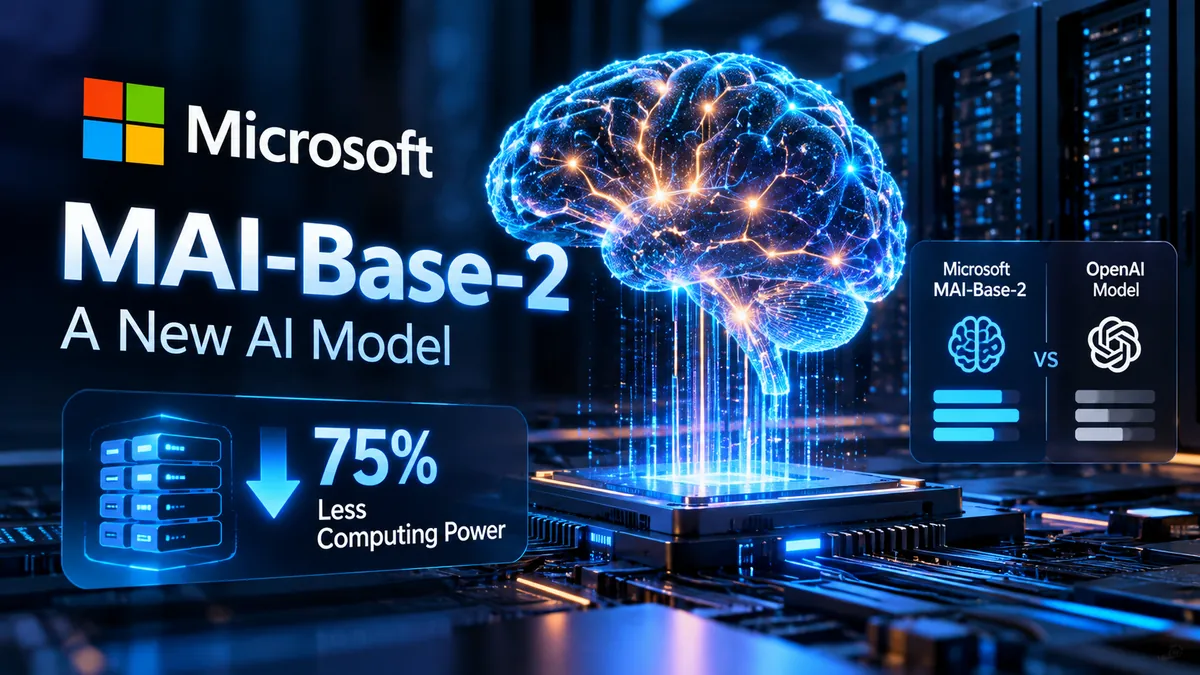
Separately, a report from Business Insider says Microsoft AI CEO Mustafa Suleyman told employees that MAI-Base-2 outperformed a comparable OpenAI base model while using approximately one-quarter of the computing resources. That comparison has not been independently verified.
What Is Microsoft MAI-Base-2?
MAI-Base-2 is a foundation model developed by Microsoft's internal AI organization. It uses a mixture-of-experts architecture, commonly called MoE.
Instead of activating every parameter for every task, a mixture-of-experts system selectively uses different parts of its neural network. This approach can help developers increase total model capacity without requiring every parameter to participate in every computation.
Microsoft says MAI-Base-2 has:
- 2.8 trillion total parameters.
- Approximately 80 billion active parameters per token.
- A mixture-of-experts architecture.
- Training that includes both text and visual information.
- A training dataset mixture totaling approximately 50 trillion tokens.
The model has completed its initial pre-training phase, but further development is still underway. It is not currently available as a public chatbot or downloadable model.
How Much Computing Power Did Microsoft Use?
Training advanced AI models requires enormous amounts of specialized hardware, electricity, and engineering expertise.
Microsoft reports that MAI-Base-2 was trained over 38 days during August and September 2026 using approximately 16,000 NVIDIA GB200 GPUs.
Those numbers illustrate the scale of modern AI development. Even when a company improves computational efficiency, training a frontier-scale model still requires substantial infrastructure.
Microsoft says its training approach achieved better efficiency than selected competitors in internal evaluations. In particular, the company estimates a 4.2- to 12.3-fold improvement in pre-training compute efficiency relative to DeepSeek-V4-Pro-Base, depending on the evaluation.
However, these figures should not be interpreted as proof that MAI-Base-2 is universally faster, cheaper, or more capable in real-world applications. The reported efficiency gains relate to specific technical comparisons, not independently tested consumer performance.
Did Microsoft Really Beat OpenAI With 75% Less Compute?
This is the most attention-grabbing part of the story, but it requires an important distinction.
According to Business Insider's reporting, Mustafa Suleyman told Microsoft employees that MAI-Base-2 performed better than a comparable OpenAI pre-trained model while using roughly 25% of the computing resources.
If that comparison is accurate, it would represent a notable achievement in model-training efficiency.
But there are three important limitations.
First, the comparison was reportedly based on internal information rather than a publicly reproducible benchmark.
Second, it concerns pre-trained models, not necessarily the finished AI assistants that consumers use.
Third, Microsoft has not publicly demonstrated that MAI-Base-2 consistently outperforms ChatGPT across everyday tasks such as writing, programming, reasoning, research, or multimodal interaction.
For now, the claim is an interesting signal of Microsoft's progress, not definitive evidence that it has overtaken OpenAI.
MAI-Base-2 vs. OpenAI: What Is the Difference?
Microsoft and OpenAI have a long-standing business relationship, but Microsoft has also been investing in its own AI research and infrastructure.
OpenAI develops models used in ChatGPT and other AI products. Microsoft integrates AI technologies into services such as Copilot while increasingly pursuing its own model-development capabilities.
MAI-Base-2 represents part of that broader strategy.
The key distinction is that MAI-Base-2 is currently a base model undergoing further development. Comparing it directly with a polished consumer-facing AI assistant would be misleading.
A fair comparison would require independently evaluated finished models, transparent testing methods, and results across multiple tasks.
Until those results are available, it is too early to declare a clear winner.
Why Microsoft's Mixture-of-Experts Architecture Matters
AI developers face a difficult challenge: larger models can offer greater capacity, but training and running them can become increasingly expensive.
Mixture-of-experts architectures offer one possible solution.
Rather than using the entire network for every token, an MoE model routes computations through selected expert components. This can reduce the amount of active computation relative to a similarly sized dense model.
For MAI-Base-2, the difference between 2.8 trillion total parameters and 80 billion active parameters is central to its design.
That does not mean the system is inexpensive to operate. Memory requirements, hardware utilization, networking, and deployment infrastructure still matter.
Nevertheless, more efficient architectures could help AI companies deliver increasingly capable systems without increasing computing costs at the same rate.
Could MAI-Base-2 Improve Microsoft Copilot?
One of the biggest questions is how Microsoft's new model might eventually influence products such as Microsoft Copilot.
Potential applications could include more efficient AI assistance, improved reasoning capabilities, enterprise workflows, and greater flexibility in how Microsoft selects models for different tasks.
However, these are possibilities rather than announced MAI-Base-2 product features.
Microsoft has not confirmed a specific Copilot release date or a consumer product powered by the finished MAI-Base-2 model.
The company has indicated that its in-house models are intended to support its broader AI ecosystem and that model weights may be licensed to selected partners through Microsoft Foundry.
For businesses, a stronger Microsoft-developed model could eventually provide another option alongside models from OpenAI and other providers.
Is MAI-Base-2 Available to Use?
As of October 16, 2026, MAI-Base-2 is not publicly available for general use.
Microsoft has completed pre-training, but post-training remains in progress. This later stage helps turn a foundation model into a system better suited to following instructions and performing practical tasks.
Microsoft has not announced:
- A public launch date.
- Consumer subscription pricing.
- General API pricing.
- Publicly downloadable model weights.
- A confirmed Copilot integration date.
Readers should be cautious about websites claiming that MAI-Base-2 can already be accessed as a finished consumer chatbot.
Why This Announcement Matters for the AI Industry
The significance of MAI-Base-2 extends beyond one company's benchmark claims.
Developing competitive in-house models could give Microsoft more control over AI research, deployment costs, infrastructure decisions, and future product development.
It also highlights a broader industry shift toward training efficiency.
For years, the AI industry has focused heavily on building larger and more powerful systems. Increasingly, companies are also competing to achieve better results with fewer computing resources.
If Microsoft can translate its reported pre-training efficiency into strong independently verified performance, MAI-Base-2 could become an important part of that shift.
For OpenAI and other AI developers, the announcement is another indication that competition is expanding beyond model quality alone to include training methods, operating costs, and deployment flexibility.
Frequently Asked Questions
What is Microsoft MAI-Base-2?
MAI-Base-2 is a large-scale mixture-of-experts foundation model developed by Microsoft AI. It contains 2.8 trillion total parameters, with approximately 80 billion active parameters per token.
Is MAI-Base-2 better than ChatGPT?
There is not enough independent evidence to establish that. Microsoft's reported comparisons involve base-model evaluations, not comprehensive public testing against the finished ChatGPT experience.
Did Microsoft use 75% less computing power than OpenAI?
Business Insider reported that Microsoft's AI chief made that claim during an internal meeting. The underlying comparison has not been independently verified.
Can I download or use MAI-Base-2 today?
No public general-access release has been announced as of October 16, 2026. The model is still undergoing post-training.
Will MAI-Base-2 power Microsoft Copilot?
It could influence future Microsoft AI products, but a specific MAI-Base-2 Copilot integration has not been confirmed.
Final Thoughts
Microsoft MAI-Base-2 is an important development in the race to build powerful and efficient AI systems.
Its 2.8-trillion-parameter architecture, large-scale training effort, and reported efficiency improvements suggest that Microsoft is strengthening its independent AI capabilities.
At the same time, the most dramatic comparisons with OpenAI remain based on internal claims rather than independently reproducible public benchmarks.
The next major milestone will be the release of a finished model and credible testing that shows how it performs in real-world applications.
For now, MAI-Base-2 is a promising foundation model—and a sign that the competition to make AI more capable and cost-efficient is far from over.
Sources: Microsoft AI's October 15, 2026 technical announcement, “Frontier Pre-training at Microsoft AI”; Business Insider's October 2026 reporting on Mustafa Suleyman's internal remarks.