ChatGPT vs Google Gemini vs Claude in 2026: Features, Pricing and Which Is Best?
Which AI assistant should you choose in 2026? Compare ChatGPT, Google Gemini and Claude across pricing, writing, coding, research and productivity.
In this article
- ChatGPT vs Gemini vs Claude: Quick Comparison
- 1. What Is ChatGPT?
- 2. What Is Google Gemini?
- 3. What Is Claude?
- 4. ChatGPT vs Gemini vs Claude: Pricing Comparison
- 5. Which AI Is Best for Writing?
- 6. Which AI Is Best for Coding?
- 7. Which AI Is Best for Research?
- 8. Which AI Is Best for Productivity?
- 9. ChatGPT vs Gemini vs Claude for Students
- 10. Which AI Assistant Should Small Businesses Choose?
- 11. ChatGPT vs Gemini vs Claude: Pros and Cons
- 12. How to Choose the Best AI Assistant
- Frequently Asked Questions
- Final Verdict: ChatGPT, Gemini or Claude?
- Official Sources and Further Reading
Choosing an AI assistant in 2026 is no longer just about finding a chatbot that can answer questions. Today's leading AI platforms can help people write, research, code, analyze files, plan projects, and work with connected applications.
Three of the most prominent options are ChatGPT by OpenAI, Google Gemini, and Claude by Anthropic.
Each platform offers useful capabilities, but their strengths, interfaces, subscriptions, and integrations differ.
So, which AI assistant should you choose in 2026?
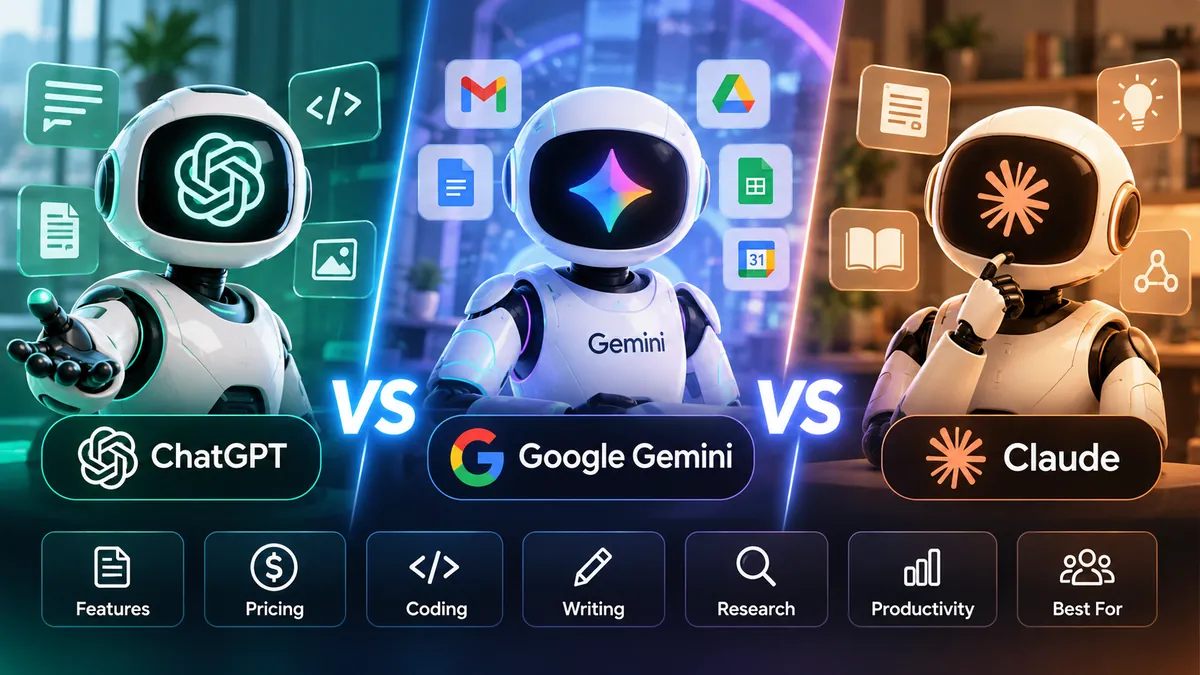
In this comparison, we examine ChatGPT vs Google Gemini vs Claude across features, pricing, writing, coding, research, productivity, and everyday use. We also explain where each platform may be a better fit and what to consider before paying for a subscription.
ChatGPT vs Gemini vs Claude: Quick Comparison
| Feature | ChatGPT | Google Gemini | Claude |
|---|---|---|---|
| Developer | OpenAI | Anthropic | |
| Free access | Available | Available | Available |
| Paid plans | Plus, Pro and business options | Google AI subscription tiers | Pro, Max and business options |
| Writing assistance | Yes | Yes | Yes |
| Coding assistance | Yes | Yes | Yes |
| File analysis | Yes, subject to plan limits | Yes, subject to plan limits | Yes, subject to plan limits |
| Research tools | Available | Available | Available |
| Image generation | Available in supported experiences | Available in supported experiences | Not a primary native Claude chat feature |
| Productivity integrations | ChatGPT tools and connected apps | Google ecosystem and connected apps | Connected tools and supported integrations |
| Best fit | Versatile general-purpose workflows | Google-centered workflows | Writing, coding and document-heavy work |
Important: This table compares platform capabilities rather than independently measured model performance. Features and limits vary by plan, region, model, and rollout.
1. What Is ChatGPT?
ChatGPT is an AI assistant developed by OpenAI.
It supports a wide range of activities, including writing, programming, document analysis, brainstorming, learning, research, and everyday problem-solving.
One of ChatGPT's major advantages is the breadth of its product experience.
Depending on the account and available tools, users can work with documents, images, voice, structured data, and connected applications.
ChatGPT Features in 2026
OpenAI's GPT-6 rollout adds another dimension to the ChatGPT experience.
GPT-6 introduces Intelligent UI, allowing certain responses to combine written explanations with visual or interactive elements.
Instead of presenting every answer as plain text, ChatGPT can use more appropriate formats for comparisons, calculations, and other tasks.
Other notable capabilities include:
- Writing and editing assistance
- Coding and debugging support
- File uploads and analysis
- Research and information organization
- Image-related tools
- Voice conversations
- Advanced reasoning options on eligible plans
- Connected applications and productivity workflows
Feature access depends on the user's subscription and current rollout status.
ChatGPT Strengths
ChatGPT is particularly attractive to users who need one AI assistant for many different types of tasks.
A student may use it for explanations, a developer for debugging, and a business professional for drafting reports.
Its flexible interface can make it useful across different workflows without requiring users to switch between specialized tools.
ChatGPT Limitations
ChatGPT can still make factual mistakes, misunderstand requests, or generate code that requires correction.
Advanced models and tools may also be restricted by subscription level or usage limits.
Users should verify important information and test generated outputs.
2. What Is Google Gemini?
Google Gemini is Google's family of AI models and assistant experiences.
Gemini can help users write, research, analyze information, understand multimodal content, and complete productivity tasks.
A major consideration is its relationship with Google's wider product ecosystem.
For people who already use Google services extensively, Gemini may offer a convenient way to incorporate AI into familiar workflows.
Google Gemini Features in 2026
Google's Gemini experience includes capabilities such as:
- Conversational assistance
- Writing and summarization
- Coding and mathematical problem-solving
- File and document understanding
- Image and video-related understanding
- Research tools
- Connected applications
- Google Workspace-related productivity features
- Different model and reasoning options
Google's subscription documentation lists AI Plus, AI Pro, and AI Ultra tiers, with different usage limits and access to advanced features.
Google Gemini Strengths
Gemini is a compelling option for users who rely heavily on Google's ecosystem.
People working with Gmail, Google Docs, Drive, or other supported Google products may benefit from integrated AI experiences.
Gemini also offers capabilities for working with multiple content types, making it relevant to research, learning, and document analysis.
Google Gemini Limitations
Some advanced features require paid subscriptions or have regional restrictions.
Available integrations can also differ between consumer accounts, business subscriptions, and enterprise configurations.
As with other AI assistants, generated information should be checked before it is used for important decisions.
3. What Is Claude?
Claude is an AI assistant developed by Anthropic.
It is designed to help users with writing, reasoning, programming, document analysis, research, and professional workflows.
Claude is particularly relevant to people who spend significant time working with long documents, technical material, and structured written content.
Claude Features in 2026
Anthropic's model family includes different options optimized for performance, speed, and workload requirements.
Its published model documentation describes the Claude Opus, Sonnet, Haiku, and Fable families.
The Claude product experience includes:
- Writing and editing assistance
- Document analysis
- Coding support
- Research capabilities
- File creation and code execution
- Projects and organizational features
- Artifacts for creating structured outputs
- Connected applications and tools
- Professional and team-oriented workflows
The exact availability of these features depends on the subscription and product environment.
Claude Strengths
Claude is worth considering for users who prioritize drafting, revising, analyzing documents, and working through technical problems.
Its coding tools and professional workflow features can also make it useful for software developers and knowledge workers.
Claude Limitations
Some features and higher usage allowances require paid subscriptions.
Claude is not necessarily the best choice for every multimedia task, and its integrations may differ from those offered by ChatGPT or Gemini.
Like all AI assistants, it can generate inaccurate information.
4. ChatGPT vs Gemini vs Claude: Pricing Comparison
Price is one of the most important considerations when choosing an AI assistant.
All three platforms provide a way to get started without paying, but their premium subscriptions offer different limits and features.
The following table summarizes selected US consumer subscription options publicly listed in October 2026.
| AI Assistant | Free Option | Selected Paid Plan | Listed Price |
|---|---|---|---|
| ChatGPT | Yes | ChatGPT Plus | $20/month |
| Google Gemini | Yes | Google AI Plus, Pro and Ultra | Varies by plan and market |
| Claude | Yes | Claude Pro | $20/month, or approximately $17/month with annual billing |
| Claude | Yes | Claude Max | From $100/month |
Prices may exclude taxes, vary by country, and change over time. Business plans, API usage, and additional services may be billed separately.
Is ChatGPT Plus Worth It?
ChatGPT Plus may be worthwhile for people who frequently use AI for writing, coding, file analysis, and research.
The value depends on whether the additional access and higher limits improve your everyday workflow.
Is Google AI Pro Worth It?
Google AI Pro may be attractive to users who want more Gemini usage and supported AI features within Google's ecosystem.
Before subscribing, review which benefits are available in your country and which Google products you actually use.
Is Claude Pro Worth It?
Claude Pro may be a good fit for users who regularly work with writing, coding, documents, and professional projects.
Users with particularly heavy workloads can also investigate Claude's higher-tier options.
5. Which AI Is Best for Writing?
Writing is one of the most common uses of generative AI.
ChatGPT, Gemini, and Claude can all help with:
- Blog post outlines
- Email drafts
- Editing and rewriting
- Summaries
- Marketing copy
- Business reports
- Creative brainstorming
However, the best choice depends on your preferences.
ChatGPT is a versatile option for people who want to combine writing with research, structured outputs, and other tools.
Google Gemini may be convenient for users who draft and organize content within Google's productivity environment.
Claude is a strong candidate for users focused on editing, document-heavy tasks, and long-form writing workflows.
Our Recommendation for Writers
Start by testing all three assistants with the same writing prompt.
Compare their clarity, tone, factual accuracy, ability to follow instructions, and how much editing each result requires.
A model that produces a polished first draft is not necessarily the one that best follows your specific editorial requirements.
For website publishers, original reporting, fact-checking, and editorial judgment remain essential.
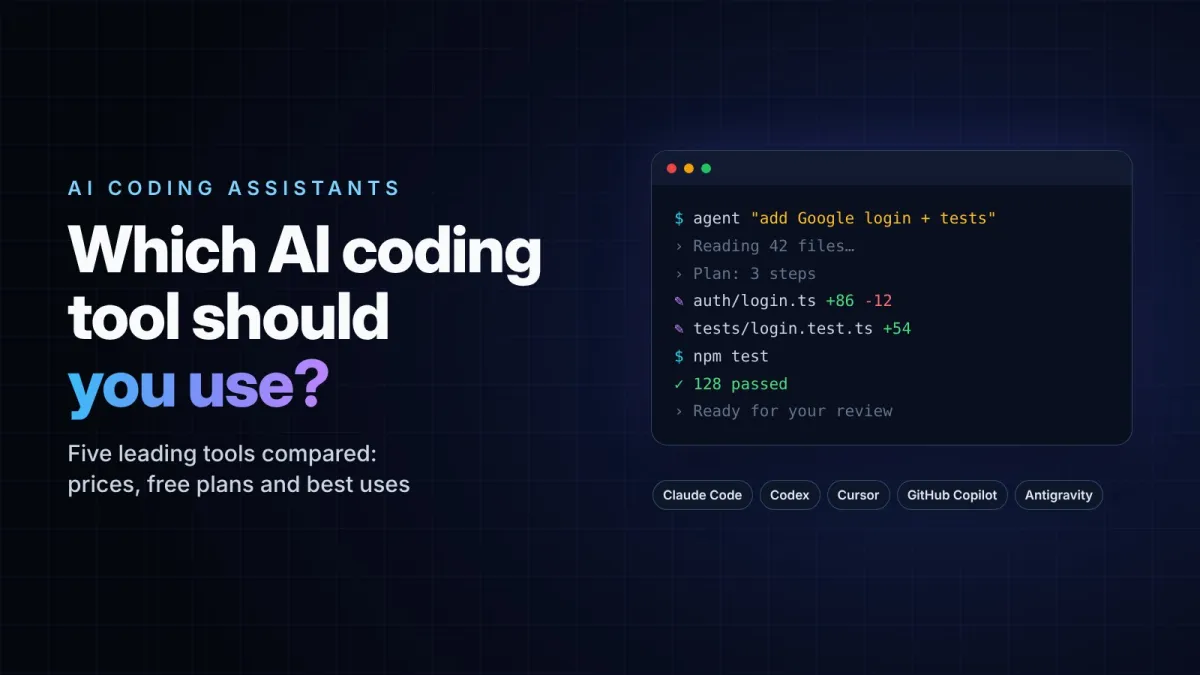
6. Which AI Is Best for Coding?
Coding is another major area of competition.
All three assistants can help explain programming concepts, generate code, review errors, and suggest improvements.
However, coding quality varies by model, language, task complexity, and the tools available.
ChatGPT for Coding
ChatGPT can help with programming questions, debugging, code explanations, and software development workflows.
OpenAI also offers Codex-related capabilities for development work.
This makes ChatGPT worth considering for developers who want conversational assistance alongside more specialized coding tools.
Google Gemini for Coding
Gemini supports programming tasks and is part of Google's broader developer ecosystem.
It may be particularly relevant to teams using Google's cloud and development technologies.
Claude for Coding
Anthropic provides Claude models and development tools intended for coding and agent-based workflows.
Claude Code and related features make it a serious option for professional developers.
Our Recommendation for Developers
Do not choose a coding assistant based only on general claims about intelligence.
Instead, test each option on your own repository and development environment.
Measure:
- Whether the code works2. How many corrections are required3. Whether tests pass4. Whether security issues are introduced5. How effectively the assistant handles existing project context6. How much the workflow costs
For production software, testing and human review are essential regardless of the model.
7. Which AI Is Best for Research?
AI assistants can make research faster by organizing information, suggesting search strategies, summarizing documents, and helping users explore complicated subjects.
But research quality depends on source access, citation reliability, and verification.
ChatGPT for Research
ChatGPT offers research-oriented tools in supported plans and environments.
These can help users gather information, organize findings, and develop structured reports.
Google Gemini for Research
Gemini includes research capabilities and may be useful for people working with Google's connected services and information tools.
Claude for Research
Claude supports research workflows and document analysis, making it relevant to users who need to work through substantial written material.
Our Recommendation for Researchers
The most important factor is not which assistant produces the longest answer.
It is which one helps you identify reliable evidence and verify conclusions efficiently.
Always open original sources, check publication dates, and distinguish established facts from speculation.
8. Which AI Is Best for Productivity?
Productivity includes much more than writing emails.
It can involve planning schedules, summarizing meetings, organizing files, analyzing data, and coordinating multi-step tasks.
Choose ChatGPT if you want a flexible assistant that supports a broad mix of personal and professional workflows.
Choose Google Gemini if much of your work already happens inside Google's ecosystem and the relevant integrations are available.
Choose Claude if your work centers on documents, technical tasks, projects, and structured professional outputs.
These are practical starting points, not universal performance rankings.
The best assistant is the one that fits the tools and processes you already use.
9. ChatGPT vs Gemini vs Claude for Students
Students can use AI to explore concepts, create practice questions, improve writing, and understand difficult material.
ChatGPT may appeal to students who want flexible explanations and interactive learning experiences.
Gemini may be useful for students who use Google tools and work with different types of learning material.
Claude may be attractive for students who need help understanding or organizing substantial reading assignments.
Regardless of the platform, students should avoid treating generated answers as automatically correct.
AI works best as a learning aid rather than a replacement for independent thinking.
10. Which AI Assistant Should Small Businesses Choose?
Small businesses often have limited budgets and need tools that provide clear value.
Before purchasing a subscription, identify the tasks that consume the most time.
Examples include
- Customer communication drafts
- Marketing content preparation
- Internal documentation
- Research and competitive analysis
- Software development assistance
- Meeting and project summaries
Then test the same workflows across the platforms.
Consider total cost, employee training, privacy requirements, supported integrations, and the amount of manual correction required.
A business already committed to Google Workspace may have different priorities from a development agency or an independent publisher.
11. ChatGPT vs Gemini vs Claude: Pros and Cons
ChatGPT
Pros
- Broad range of use cases
- Flexible conversational and interactive experiences
- Writing, coding, research, and file-related tools
- Multiple subscription options
Cons
- Advanced features may require payment- Usage limits can apply- Responses still require verification
Google Gemini
Pros
- Strong connection to Google's ecosystem- Multimodal capabilities- Research and productivity features- Multiple subscription tiers
Cons
- Feature availability can vary by region and plan- Some integrations require particular account configurations- Output quality varies by task
Claude
Pros
- Useful for writing and document-focused workflows- Coding and professional productivity tools- Multiple model options- Free and paid access
Cons
- Higher usage levels require paid plans- Some multimedia workflows may be better served by other products- Integrations and availability vary
12. How to Choose the Best AI Assistant
Before committing to a paid plan, complete a simple comparison.
Step 1: Define Your Main Use Case
Are you primarily writing, coding, researching, studying, or managing business tasks?
Step 2: Test the Free Versions
Try the same three or four realistic tasks in ChatGPT, Gemini, and Claude.
Step 3: Evaluate Accuracy
Check important claims, calculations, and technical outputs.
Step 4: Compare Workflow Convenience
Consider whether the assistant works with your existing applications and files.
Step 5: Review Subscription Limits
A lower monthly price is not necessarily better if you regularly encounter limits that interrupt your work.
Step 6: Choose Based on Results
Select the tool that consistently helps you complete your actual tasks with the least effort and acceptable cost.
Frequently Asked Questions
Is ChatGPT better than Google Gemini?
Neither is universally better. ChatGPT offers a broad range of AI experiences, while Gemini may be particularly convenient for users of Google's ecosystem. The right choice depends on your tasks and available features.
Is Claude better than ChatGPT for writing?
Claude is worth testing for writing and document-heavy work, but there is no universal winner. Compare outputs using your own writing requirements.
Which AI is best for coding in 2026?
ChatGPT, Gemini, and Claude all offer coding assistance. The best option depends on your programming language, project complexity, development tools, and testing results.
Which AI assistant is free?
All three offer free access, although features, usage limits, and regional availability differ.
How much does ChatGPT Plus cost?
OpenAI lists ChatGPT Plus at $20 per month in the United States. Taxes and regional billing details may vary.
How much does Claude Pro cost?
Anthropic lists Claude Pro at $20 per month with monthly billing, or approximately $17 per month when billed annually.
Can Gemini work with Google Workspace?
Google provides Gemini capabilities across supported Google products and subscriptions. Availability depends on the service, plan, and account configuration.
Can I use more than one AI assistant?
Yes. Some users benefit from using different assistants for different tasks. However, maintaining multiple paid subscriptions may not be cost-effective unless each provides measurable value.
Are AI assistants always accurate?
No. ChatGPT, Gemini, and Claude can all make mistakes. Important information should be verified independently.
Which AI is best overall in 2026?
There is no single best assistant for every person. ChatGPT is a versatile general-purpose choice, Gemini is worth considering for Google-centered workflows, and Claude is a compelling option for writing, coding, and document-focused work.
Final Verdict: ChatGPT, Gemini or Claude?
ChatGPT, Google Gemini, and Claude are all capable AI assistants, but they approach productivity and user experience differently.
Choose ChatGPT if you want a flexible, general-purpose AI assistant with a wide variety of tools and interactive experiences.
Choose Google Gemini if you regularly use Google products and want to explore AI features connected to that ecosystem.
Choose Claude if your priorities include writing, document analysis, coding, and structured professional work.
For most users, the smartest approach is to begin with the free versions, test real tasks, and upgrade only when the additional capabilities justify the cost.
The AI market changes quickly, so the best choice today may not remain the best choice for every workflow tomorrow.
Ultimately, the right AI assistant is not simply the one with the newest model or the longest feature list. It is the one that helps you produce accurate, useful work efficiently.
Official Sources and Further Reading
- [OpenAI — GPT-6 and Other Models in ChatGPT](https://help.openai.com/en/articles/20001354-gpt-6-and-other-models-in-chatgpt)- [OpenAI — ChatGPT Plus](https://help.openai.com/en/articles/6950777-what-is-chatgpt-plus)- [Google — Gemini Apps Limits and Upgrades](https://support.google.com/gemini/answer/16275805?hl=en)- [Google — Google AI Pro Benefits](https://support.google.com/googleone/answer/14534406?hl=en)- [Anthropic — Claude Plans and Pricing](https://claude.com/pricing)- [Anthropic — Claude Model Documentation](https://platform.claude.com/docs/en/models/overview)
Editorial note: This comparison reflects publicly documented product information available in October 2026. Subscription prices, models, feature access, and usage limits may change. Readers should consult the providers' official websites for current details.