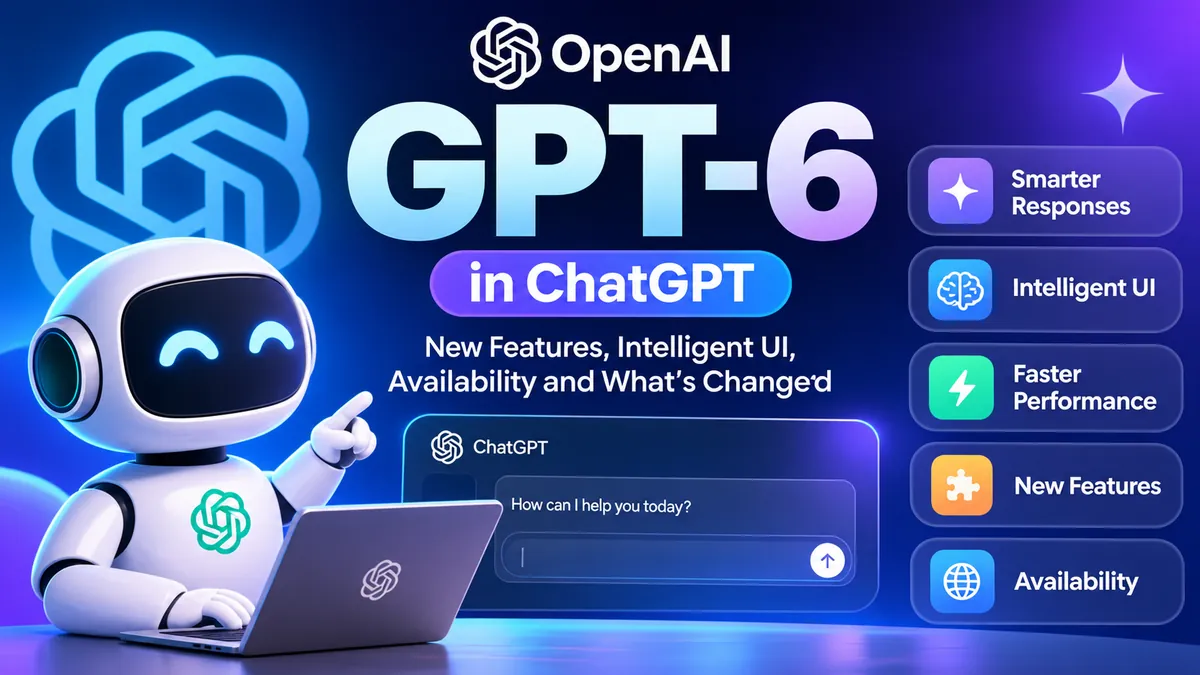
GPT-6 in ChatGPT: New Features, Intelligent UI, Availability and What's Changed
A practical look at GPT-6 in ChatGPT, its Intelligent UI experience, potential applications, availability and the questions users should consider.
In this article
- What Is GPT-6?
- What Is Intelligent UI in ChatGPT?
- Key GPT-6 Features and Improvements
- GPT-6 vs Previous ChatGPT Generations
- GPT-6 Availability: How Can Users Access It?
- Practical GPT-6 Use Cases
- Limitations and Risks
- What Does Intelligent UI Mean for the Future of AI?
- Frequently Asked Questions
- Final Thoughts
- Sources and Further Reading
Artificial intelligence is changing not only what digital assistants can do, but also how people interact with them. OpenAI's GPT-6 generation and the introduction of Intelligent UI represent a shift toward more responsive, visual, and interactive AI experiences.
Instead of treating every question as a request for a long text response, ChatGPT can present information using structured comparisons, visual elements, and interactive tools when those formats are more useful.
In this guide, we explore GPT-6 in ChatGPT, explain the idea behind Intelligent UI, examine practical applications, and discuss availability, limitations, and what users should consider.
What Is GPT-6?
GPT-6 is a generation of OpenAI's artificial intelligence models used to power ChatGPT experiences.
Like earlier generations, it is designed to help people work with language, solve problems, explore information, write content, and complete a variety of tasks.
However, an important part of the GPT-6 experience is how the assistant communicates its results.
A useful AI assistant should do more than produce an answer. It should also make that answer easy to understand, evaluate, and act upon.
This is where Intelligent UI becomes particularly relevant.
What Is Intelligent UI in ChatGPT?
Intelligent UI is an approach to presenting AI-generated responses through a combination of written explanations, structured layouts, and interactive components.
For example, a traditional chatbot might explain the differences between several software products in a long paragraph.
An interface-aware assistant can instead organize the same information into a comparison table, making the differences easier to identify.
Depending on the available features and the user's request, an interactive response may include:
- Comparison tables and structured information- Charts and visual explanations- Interactive calculators- Forms and selection controls- Maps and location-based presentations- Step-by-step learning experiences
The purpose is not to make every response visually complex. A simple question may still be best answered with a short paragraph.
The key principle is choosing the presentation that makes information most useful.
Key GPT-6 Features and Improvements
1. More Interactive Responses
One of the most interesting developments in modern AI assistants is the movement beyond static text.
Interactive responses can allow users to adjust inputs, compare alternatives, and explore results directly.
Consider someone planning a monthly budget.
Rather than receiving only a written explanation, the user could benefit from an interface where changing income or expenses immediately updates the calculation.
This approach can make AI assistance more practical.
2. Better Information Presentation
Complex information is often easier to understand when it is organized visually.
A comparison of AI tools, for example, might include separate columns for pricing, capabilities, limitations, and intended users.
A technical explanation could use a diagram to demonstrate how different components interact.
By selecting an appropriate format, an AI assistant can reduce unnecessary reading and make important details easier to find.
3. More Responsive Conversations
Another area of development is the way AI systems deliver responses during complex tasks.
Rather than making users wait for every part of a lengthy response, an assistant may begin presenting useful information while continuing to work on additional details.
This can improve the experience of researching complicated topics, writing documents, and exploring multi-step problems.
Actual performance still depends on the task, available tools, and system conditions.
4. Practical Tools Within ChatGPT
Interactive AI experiences can be useful for everyday activities.
Examples include:
- Splitting a restaurant bill among friends- Comparing different savings scenarios- Exploring educational simulations- Organizing travel plans- Evaluating software features- Creating simple planning tools
These examples illustrate how AI can move from explaining a process to helping users interact with it.
GPT-6 vs Previous ChatGPT Generations
Earlier ChatGPT experiences established conversational AI as a practical tool for writing, research, brainstorming, coding, and everyday questions.
Newer experiences build on those foundations while placing greater emphasis on usability.
| Area | Traditional ChatGPT Experience | GPT-6 With Intelligent UI |
|---|---|---|
| Presentation | Primarily conversational text | Text combined with structured and interactive elements |
| Comparisons | Written explanations and tables | More flexible visual comparisons |
| Calculations | Explanations and numerical results | Potentially interactive calculation tools |
| Learning | Step-by-step written guidance | Visual and interactive learning experiences |
| User interaction | Follow-up messages | Follow-up messages and interface controls |
These are differences in the interaction experience, not independent benchmark measurements.
A newer model should not automatically be assumed to outperform every previous model in every situation.
For coding accuracy, mathematical reasoning, factual reliability, and other measurable capabilities, readers should consult published evaluations rather than relying on marketing claims.
GPT-6 Availability: How Can Users Access It?
GPT-6 availability depends on OpenAI's current rollout, supported products, account eligibility, and subscription settings.
Users who want to check their access should:
- Open ChatGPT.2. Sign in to their account.3. Check the available model options.4. Review any feature announcements shown in the application.5. Consult OpenAI's official release notes for the latest details.
Not every feature necessarily becomes available to every account at the same time.
Additionally, the models used in ChatGPT, developer tools, and other OpenAI products may differ.
For this reason, users should verify availability in the specific product they intend to use.
Practical GPT-6 Use Cases
Content Creation and Editing
Writers, marketers, and editors can use ChatGPT to develop article outlines, improve clarity, compare headlines, and organize research.
For publishers, AI-generated suggestions should always be reviewed for accuracy and originality.
Publishing large quantities of unverified AI-generated material is not a substitute for genuine editorial value.
Coding and Software Development
Developers can use AI assistance to explain programming concepts, review code, generate examples, and investigate errors.
Generated code should be tested before deployment, particularly when it affects authentication, payments, databases, or sensitive information.
Education and Learning
Students can ask for explanations adapted to their level of knowledge.
Interactive examples can be especially useful when learning mathematics, statistics, programming, or scientific concepts.
However, students should independently verify important facts and calculations.
Business Productivity
Professionals can use ChatGPT to organize meeting notes, compare business options, prepare documents, and analyze non-sensitive information.
The greatest value often comes from combining AI assistance with human judgment and domain expertise.
Research and Decision Support
AI can help users organize information and identify questions worth investigating.
It should not be treated as an infallible source.
When researching products, prices, scientific findings, or important decisions, users should consult original sources.
Limitations and Risks
Even advanced AI systems can produce incorrect or misleading information.
A polished interactive interface does not guarantee that the information behind it is accurate.
Users should keep several limitations in mind.
Factual errors: AI responses may include incorrect details or unsupported claims.
Outdated information: Product availability, prices, and technical specifications can change.
Calculation errors: Important numerical results should be independently checked.
Privacy: Sensitive personal or business information should only be shared when appropriate.
Generated tools: Interactive calculations and software should be tested before being used for consequential decisions.
Overreliance: AI assistance is most useful when combined with critical thinking and verification.
These considerations apply regardless of how advanced the interface becomes.
What Does Intelligent UI Mean for the Future of AI?
Intelligent UI points toward a broader evolution in human-computer interaction.
Traditional search engines help users find information. Conversational assistants help explain it. Interactive AI systems may increasingly help users explore information and complete tasks within the same environment.
This could be particularly valuable in education, productivity, research, and everyday planning.
However, the quality of an AI experience depends on more than visual presentation.
Accuracy, transparency, privacy, accessibility, and user control remain essential.
The most successful AI interfaces will be those that make difficult tasks easier without hiding important assumptions or limitations.
Frequently Asked Questions
What is GPT-6 in ChatGPT?
GPT-6 refers to a generation of OpenAI models associated with ChatGPT. The experience emphasizes advanced AI assistance and more flexible ways to present responses.
What is Intelligent UI?
Intelligent UI allows ChatGPT to present certain answers through structured visual elements and interactive controls instead of relying exclusively on plain text.
Is GPT-6 better than previous models?
Performance depends on the task and evaluation method. Improvements in interface design should not be confused with verified improvements in every model capability.
Can GPT-6 help with coding?
ChatGPT can assist with coding explanations, examples, debugging, and development workflows. Generated code still requires testing and security review.
Can GPT-6 create interactive calculators?
Interactive AI interfaces can support calculator-style experiences. The exact features available depend on the current ChatGPT product and account.
Is GPT-6 available for free?
Availability and usage limits depend on OpenAI's current plan offerings and rollout. Check the official ChatGPT interface and release notes for the latest information.
Should businesses trust GPT-6 responses without checking them?
No. Businesses should verify important outputs, protect sensitive information, and maintain human review for consequential decisions.
Final Thoughts
GPT-6 and Intelligent UI highlight an important direction for AI assistants: moving beyond simply generating answers toward making information easier to explore and use.
Interactive tools, structured comparisons, and flexible visual explanations can improve the experience of working with artificial intelligence.
At the same time, usability should never replace accuracy or responsible use.
For individuals and businesses, the most important question is whether these capabilities solve real problems more effectively.
As AI technology continues to develop, the combination of powerful models, reliable information, and thoughtful interface design will shape the next generation of digital assistance.
Sources and Further Reading
- [OpenAI — Official Website](https://openai.com/)- [OpenAI — ChatGPT Release Notes](https://help.openai.com/en/articles/6825453-chatgpt-release-notes)- [OpenAI — GPT-6 Announcement](https://openai.com/index/gpt-6-for-everyone/)- [OpenAI — ChatGPT](https://chatgpt.com/)
Editorial note: Product features, subscription availability, and rollout details may change. Readers should consult OpenAI's official documentation for current information.