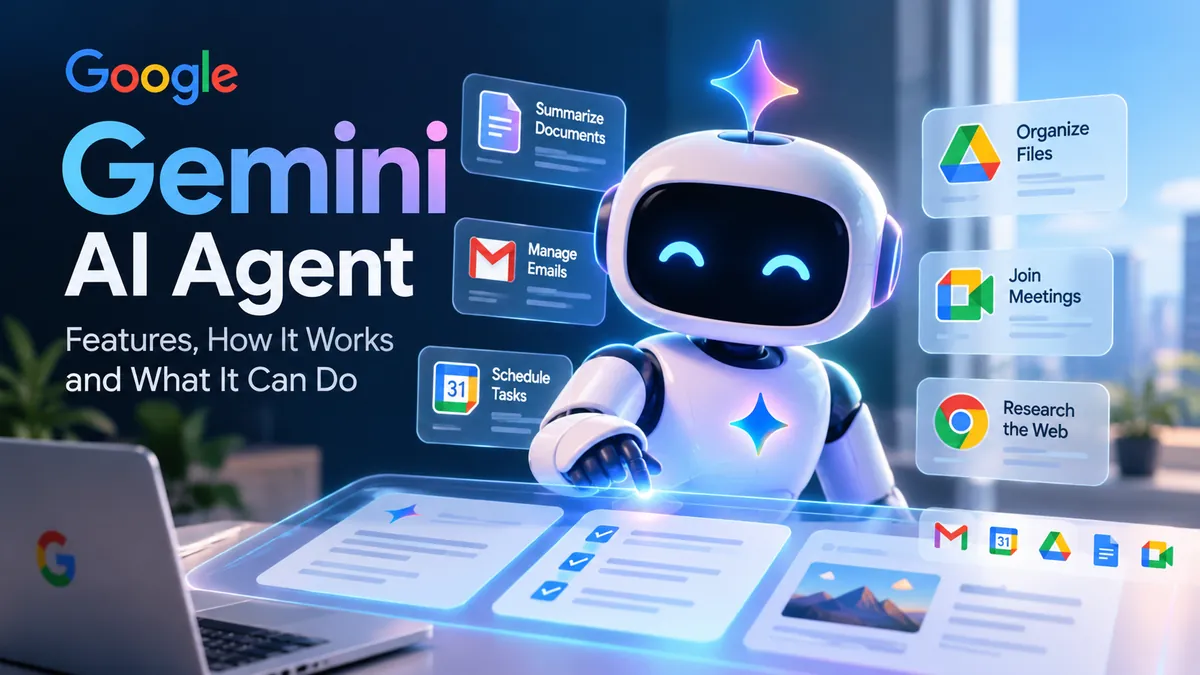
Google Gemini AI Agent: Features, How It Works and What It Can Do
Google Cloud introduced its Gemini AI Agent in October 2026. Here's how the agent plans tasks, connects to business tools and helps teams complete work.
In this article
- What Is Google Gemini AI Agent?
- When Was the Gemini Agent Announced?
- How Does Google Gemini AI Agent Work?
- Key Features of Google Gemini AI Agent
- What Can Google Gemini AI Agent Do?
- Project Management Support
- Is Google Gemini AI Agent the Same as Gemini Spark?
- Google Gemini AI Agent Availability and Pricing
- Benefits of AI Agents for Businesses
- Limitations and Risks
- How Businesses Can Prepare for Gemini AI Agent
- Frequently Asked Questions
- Final Thoughts
- Sources and Further Reading
Google is taking another major step toward AI-powered work automation. On October 8, 2026, Google Cloud introduced the Gemini agent at its Gemini at Work event, describing it as a universal AI agent designed for professional workflows.
Unlike a conventional chatbot that primarily answers questions, the Gemini agent is designed to plan tasks, use tools, connect with business systems, and help deliver completed work within the applications people already use.
This development reflects a broader shift in artificial intelligence: from systems that generate information to systems that can help people take action.
In this guide, we explain what the Google Gemini AI Agent is, how it works, its main features, potential business applications, availability considerations, and limitations.
What Is Google Gemini AI Agent?
The Google Gemini AI Agent is an AI-powered work assistant announced by Google Cloud in October 2026.
According to Google's announcement, the agent brings together organizational context, planning capabilities, connected tools, and enterprise controls in a unified experience.
Its purpose is to help users complete work across different systems without manually coordinating every step.
For example, a business professional might need to gather information from several documents, prepare a summary, and produce a finished report.
A traditional AI chatbot could help write the report, but the user might still need to find the documents, copy information between applications, and organize the final output.
An AI agent aims to handle more of that workflow by planning the necessary steps and using connected tools when permitted.
The result is a more task-oriented approach to AI assistance.
When Was the Gemini Agent Announced?
Google Cloud announced the Gemini agent on October 8, 2026, during Gemini at Work 2026.
The company presented it as a universal agent for work, emphasizing its ability to operate across business contexts and connected systems.
Google highlighted several central capabilities:
- Understanding relevant organizational context
- Planning work across multiple steps
- Using skills and connected tools
- Working with enterprise business systems
- Producing results in existing work environments
- Selecting appropriate models for different tasks
- Supporting cost controls, security, administration, and governance
These capabilities are particularly relevant to organizations that want to move beyond isolated AI chat experiences.
How Does Google Gemini AI Agent Work?
The basic concept behind an AI agent is straightforward: a user describes a goal, and the system determines how to approach it.
A typical agent-based workflow may involve several stages.
Step 1: The User Provides a Goal
The process begins with a natural-language instruction.
For example:
"Prepare a weekly project update using the latest available documents and summarize the main risks."
This request describes an outcome rather than a sequence of manual actions.
Step 2: The Agent Plans the Task
The agent determines which steps may be necessary.
These could include identifying relevant sources, collecting information, organizing findings, and preparing a final document.
The exact planning process depends on the available tools, permissions, and product configuration.
3: The Agent Uses Connected Tools
Google says the Gemini agent can connect with business systems and use tools and skills to complete work.
In an enterprise environment, these connections may allow an agent to work with information distributed across multiple applications.
However, an agent should only access information and perform actions within its authorized permissions.
Step 4: The Agent Produces a Result
The final goal is to return useful work rather than merely explain how someone could complete it.
Google describes this as delivering results within familiar environments, including documents, inboxes, and developer tools.
Step 5: The User Reviews the Output
Even when a task is automated, human review remains important.
Users should check factual accuracy, confirm that the output meets their requirements, and approve consequential actions where appropriate.
Key Features of Google Gemini AI Agent
1. Multi-Step Task Planning
Many business activities require more than one action.
Preparing a report, for instance, might involve finding relevant data, checking recent changes, organizing information, and writing conclusions.
An AI agent can help coordinate these steps as part of a larger workflow.
This is one of the main differences between agent-based systems and basic question-answering tools.
2. Business Context Awareness
Google emphasizes that its Gemini agent can use an organization's business context.
Context matters because a useful workplace assistant must understand the relevant documents, processes, and information sources.
Without that context, an AI system may generate generic responses that do not reflect how a particular organization operates.
Access to organizational information should remain subject to security controls and permissions.
3. Connected Business Tools
Modern businesses often work across many applications.
An agent that can interact with connected systems may reduce the need for employees to switch between tools and manually transfer information.
The exact integrations available depend on the product, administrator settings, and supported connections.
4. Model Selection for Different Tasks
Google says the Gemini agent can choose an appropriate model for the job.
Different tasks may require different balances of reasoning capability, speed, and computational cost.
Selecting models according to task requirements could help organizations manage performance and expenses.
However, actual cost savings depend on usage patterns and deployment settings.
5. Enterprise Security and Governance
Security is essential when AI systems interact with business information.
Google identifies administration, governance, and security as core parts of its enterprise agent approach.
Organizations evaluating the technology should review how permissions, auditability, data handling, and approval processes work in their specific environment.
6. Results Within Existing Workflows
One of the most practical goals of the Gemini agent is to produce work where users already operate.
Instead of requiring people to manually transfer AI-generated content into another application, the agent is intended to support completion within existing business environments.
This could make AI assistance more useful for recurring workplace tasks.
What Can Google Gemini AI Agent Do?
The potential applications extend across different professional activities.
Document Research and Summarization
An agent could help collect information from authorized documents, identify relevant details, and prepare summaries.
For example, a team might use an AI-assisted workflow to organize project documentation before a meeting.
Any resulting summary should be checked against its original sources.
Project Management Support
Project managers frequently need to review updates, identify outstanding tasks, and communicate progress.
An AI agent could help organize this information and prepare draft status reports when the necessary integrations are available.
Email and Communication Workflows
Workplace agents may assist with drafting communications, organizing information, and preparing follow-up materials.
Sending messages or making commitments on behalf of a user should remain subject to appropriate permissions and confirmation.
Software Development
Google includes developer environments among the places where the Gemini agent can help deliver results.
Possible workflows include organizing technical tasks, assisting with code-related work, and preparing development materials.
Developers should still test generated code and review security-sensitive changes.
Business Analysis
An agent could help bring together authorized information from different business sources and produce structured reports.
This may be useful for operational reviews, planning, and internal knowledge work.
AI-generated analysis should not replace independent verification of important figures or business assumptions.
Google Gemini AI Agent vs Traditional AI Chatbots
The difference is primarily about the type of work being performed.
| Capability | Traditional AI Chatbot | AI Agent |
|---|---|---|
| Answer questions | Yes | Yes |
| Draft text | Yes | Yes |
| Plan multi-step work | May provide instructions | Designed to coordinate steps |
| Use connected tools | Depends on product | Central to agent workflows |
| Access business context | Depends on integrations | Important design goal |
| Complete actions | Often limited | Possible with permissions and tools |
| Human oversight | Required | Required |
This comparison describes general product approaches rather than a universal technical distinction.
Some advanced chatbots already include agent-like capabilities, and not every AI agent supports every type of action.
Is Google Gemini AI Agent the Same as Gemini Spark?
No. They are related to Google's broader AI agent strategy, but they should not be treated as identical products.
Google Cloud's Gemini agent, announced in October 2026, is positioned as a universal agent for professional and enterprise work.
Gemini Spark, introduced earlier in 2026, is described by Google as a personal AI agent designed to help individuals manage aspects of their digital lives under their direction.
Both reflect Google's interest in AI systems that can take action, but their intended audiences and product environments differ.
Users should check the official documentation for the particular agent they want to use.
Google Gemini AI Agent Availability and Pricing
Google announced the Gemini agent on October 8, 2026, but an announcement does not necessarily mean every feature is immediately available to all users.
Availability may depend on enterprise products, geographic rollout, organizational eligibility, administrator configuration, and supported integrations.
Similarly, pricing can vary according to the product or service through which the agent is offered.
Before making a purchasing decision, businesses should confirm:
- Whether the Gemini agent is available to their organization
- Which Google Cloud or Workspace services are required
- What subscription or usage charges apply
- Which business systems are supported
- What administrator permissions are necessary
- Which security and compliance controls are available
For the latest commercial details, consult Google's official product documentation or sales channels.
Benefits of AI Agents for Businesses
AI agents may offer several advantages when implemented responsibly.
Reduced repetitive work: Automating routine steps can free employees to focus on activities that require judgment and creativity.
Better workflow coordination: Connected tools can help reduce manual movement between applications.
More consistent processes: Clearly defined instructions may help standardize recurring tasks.
Faster information access: Agents with appropriate permissions may help employees locate relevant organizational knowledge.
Greater flexibility: Businesses can potentially use agent-based workflows across different departments and functions.
These benefits are possibilities rather than guaranteed outcomes. Results depend on the quality of integrations, task design, governance, and human oversight.
Limitations and Risks
AI agents also introduce challenges that organizations should consider carefully.
Incorrect Information
An agent may misunderstand instructions or produce inaccurate results.
Important outputs should be checked against reliable sources.
Excessive Permissions
Giving an AI agent broad access to company systems can create unnecessary security risks.
Organizations should apply appropriate access controls and limit permissions to what each workflow requires.
Automation Errors
An error in a multi-step workflow may affect later steps.
Testing, monitoring, and approval checkpoints can reduce the impact of mistakes.
Privacy and Compliance
Businesses should understand how their information is processed and what contractual and regulatory requirements apply.
Cost and Complexity
Integrating AI agents into existing workflows may involve subscription costs, technical configuration, employee training, and ongoing maintenance.
A successful implementation requires more than simply enabling a new AI feature.
How Businesses Can Prepare for Gemini AI Agent
Organizations interested in agent-based AI can begin with a practical evaluation process.
1. Identify repetitive workflows. Look for tasks involving multiple predictable steps.2. Review data access. Determine which systems and information sources the agent would need.3. Define permissions. Restrict access to the minimum necessary scope.4. Start with low-risk tasks. Test summarization, drafting, or internal reporting before automating consequential actions.5. Measure results. Compare time savings, accuracy, operating costs, and employee feedback.6. Maintain oversight. Establish clear review and approval requirements.
This approach can help organizations understand where AI agents provide measurable value.
Frequently Asked Questions
What is Google Gemini AI Agent?
Google Gemini AI Agent is an AI-powered workplace agent announced by Google Cloud in October 2026. It is designed to plan tasks, use connected tools, and help complete work across business systems.
When did Google announce the Gemini agent?
Google Cloud announced the Gemini agent on October 8, 2026, at Gemini at Work 2026.
Can Gemini AI Agent automate tasks?
Task planning and tool-based execution are central to its design. Actual automation capabilities depend on the available integrations, permissions, and product configuration.
Is Gemini AI Agent available to everyone?
Availability depends on Google's rollout and the relevant product or enterprise offering. Users should consult official Google documentation for current access details.
Is Gemini AI Agent free?
The October announcement does not establish a universal free offering. Businesses should verify pricing and eligibility for their intended deployment.
Can Gemini AI Agent work with business documents?
Google describes the agent as capable of using organizational context and producing work in familiar environments, including documents. Specific capabilities depend on supported connections and access permissions.
Is Gemini AI Agent different from Gemini Spark?
Yes. Google's Gemini agent is positioned for workplace and enterprise use, while Gemini Spark is presented as a personal AI agent.
Is Google Gemini AI Agent safe for business use?
Google highlights enterprise security and governance controls. Organizations must still evaluate permissions, privacy, compliance, and operational risks before deployment.
Final Thoughts
Google's October 2026 Gemini agent announcement marks another step in the evolution of workplace artificial intelligence.
The focus is shifting from AI systems that simply respond to prompts toward assistants that can plan work, interact with authorized tools, and help deliver completed results.
For businesses, the opportunity is significant, but so is the need for responsible implementation.
Organizations should focus on real operational needs, carefully manage permissions, and measure whether AI-assisted workflows genuinely improve productivity.
As Google expands its agent-based ecosystem, the most important developments to watch will be practical availability, supported integrations, security controls, and measurable business outcomes.
Sources and Further Reading
- [Google Cloud introduces the Gemini agent — October 8, 2026](https://blog.google/innovation-and-ai/infrastructure-and-cloud/google-cloud/gemini-at-work/)- [Google's Gemini news and announcements](https://blog.google/products-and-platforms/products/gemini/)- [The Gemini app becomes more agentic — May 19, 2026](https://blog.google/innovation-and-ai/products/gemini-app/next-evolution-gemini-app/)- [Introducing Managed Agents in the Gemini API](https://blog.google/innovation-and-ai/technology/developers-tools/managed-agents-gemini-api/)
Editorial note: Product capabilities, pricing, integrations, and availability may change. Readers should verify current details using Google's official documentation.