Google Gemini 4 Argon: Features, Pricing, Availability and How It Compares
Gemini 4 Argon is now generally available. Here's what Google's long-context AI model can do, how much it costs before and after December 1, who can use it, and how it compares with Gemini 4 Carbon, Claude and GPT-6.

In this article
Updated November 1, 2026: Gemini 4 Argon is now generally available. This guide has been updated with current access options, final API specifications, independent test results and how Argon compares with Google's newer Gemini 4 Carbon.
Google announced Gemini 4 Argon on September 30, 2026 as the first model in its Gemini 4 family. At first, only a small group of cybersecurity defenders could use it. Two weeks later, on October 13, Google opened it to paying developers, businesses and Gemini app subscribers around the world.
Argon is built for long, complex work rather than quick chat answers: large coding projects, research that runs over many steps, legal and financial analysis, and defensive security tasks. Here is what it can do, how much it costs, who can use it and whether it is the right Google model for you now that an even newer one has arrived.
Gemini 4 Argon at a glance
| Gemini 4 Argon | |
|---|---|
| Announced | September 30, 2026 |
| Generally available | October 13, 2026 |
| API model ID | gemini-4-argon |
| Context window | About 1 million tokens, shared by input and output |
| Default output per request | 65,536 tokens (longer outputs possible with "long decode") |
| Inputs | Text, images, video, audio and PDF |
| Output | Text only |
| API price until November 30, 2026 | $2 per 1M input tokens, $10 per 1M output tokens |
| API price from December 1, 2026 | $4 per 1M input tokens, $20 per 1M output tokens |
| Free access | No |
Where can you use Gemini 4 Argon?
Since October 13, Argon has been available in several places, but none of them is free:
- Gemini app and AI Mode in Search: for Google AI Pro and Google AI Ultra subscribers.
- Gemini API and Google AI Studio: on the paid tier only. Argon is not available on the API's free tier.
- Google Cloud (Vertex AI) and Gemini for business: for companies using Google Cloud.
- Google Antigravity: Google's coding agent platform, for Google AI Ultra subscribers at launch.
If you used Gemini CLI in the past, note that it does not support Argon. Google now points developers to the Antigravity command-line tool instead.
What changed from the original announcement
When Google first revealed Argon, it highlighted a "1 million token output limit". The final specification is more nuanced. Argon has a context window of about one million tokens that is shared between what you send and what it writes. A normal request returns up to 65,536 tokens. For very long jobs, developers can use a background mode Google calls long decode, which lets the model keep writing up to the space left in its context window.
In practice, this means most people will never hit the limit. It matters mainly for developers running long agent tasks, such as rewriting a large codebase or producing a very long report in one go.
The rollout also moved faster than many expected. Google originally said it would expand access gradually after testing with trusted security teams, and that phase lasted just under two weeks.
What Gemini 4 Argon is good at
Large software projects
Google has used Argon internally for some ambitious coding work, including migrating C and C++ code to the memory-safe Rust language. Google says Argon agents worked on codebases from tens of thousands of lines up to more than 800,000 lines for the Fuchsia Zircon kernel. In another case, agents replaced about 32,000 lines of code in a Rust port of Google's libgav1 video decoder, and Google reports the result ran 2.7 times faster with identical output.
These are company-reported results, and Google says important changes were still reviewed and tested by people before use.
Research and professional work
Argon is aimed at tasks that require reading a lot of material and keeping track of it over many steps, such as financial research or drafting legal documents. Google also says Argon helped its quantum computing team improve one part of a calculation by 40% and found memory savings that freed more than 300 TiB across Google's infrastructure.
For legal, financial or medical work, AI output still needs careful checking by a qualified person. A model that writes more can also make more mistakes.
Security work
Argon's first users were security teams in Google's Fairwind Program, testing it on defensive tasks such as finding and patching vulnerabilities. On Gray Swan's indirect prompt-injection benchmark, where hidden instructions inside content try to hijack the model, attacks succeeded only 0.7% of the time.
How well does Argon perform?
Google's own launch tests showed Argon ahead of Claude Opus 5.5 and GPT-6 Astra on several benchmarks, but not all of them:
| Benchmark (Google-reported) | Gemini 4 Argon | Claude Opus 5.5 | GPT-6 Astra |
|---|---|---|---|
| DeepSWE v1.1 (coding) | 77.9% | 74.2% | 74.1% |
| GraphWalks (very long documents) | 84.2% | 66.8% | 71.8% |
| LVBench (long video) | 91.7% | 83.7% | 87.5% |
| Terminal-Bench 4.0 (command line) | 57.4% | 66.4% | 58.2% |
| FrontierSWE v2 (coding) | 55.0% | 62.3% | 65.5% |
The pattern is clear: Argon is especially strong when it has to work with very large amounts of information, while Anthropic's and OpenAI's models still lead on some coding and command-line tests.
Independent results are a little more modest. On Artificial Analysis's Intelligence Index, Argon scored 50, and on its Coding Agent Index it scored 53. One clear strength stands out, though: Artificial Analysis measured a hallucination rate of just 4% on its Omniscience test, which means Argon is less likely than many rivals to invent facts when it doesn't know an answer.
What does Argon cost?
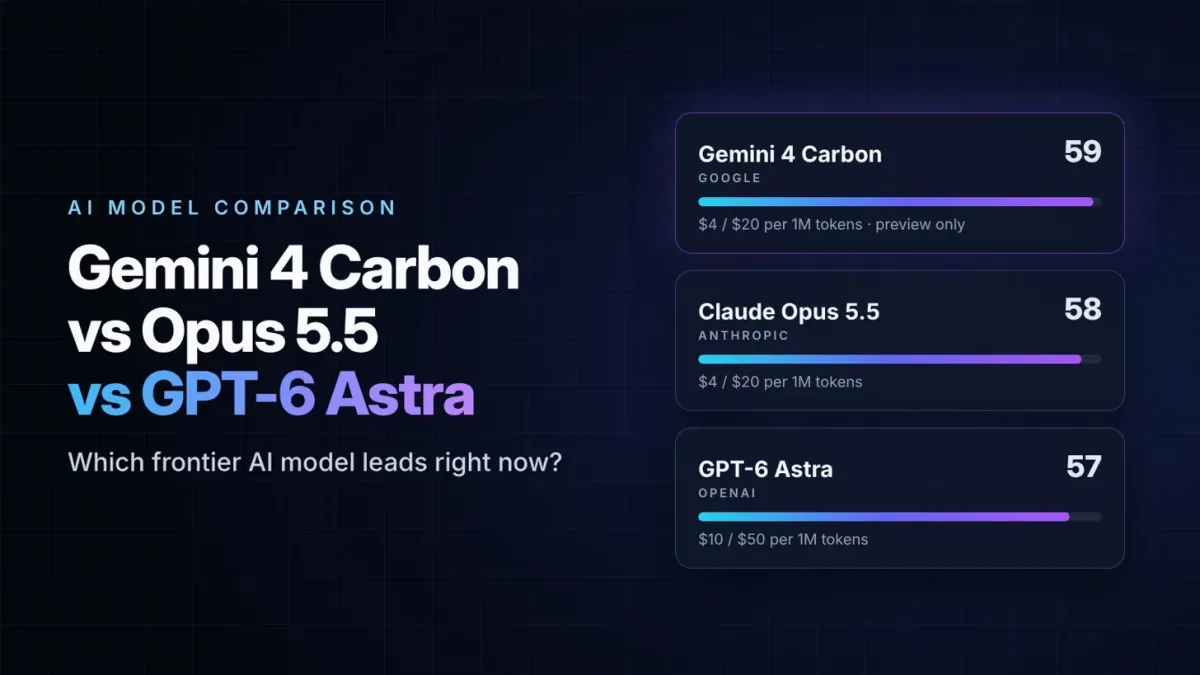
For developers, Argon is cheaper than many people expect from a frontier model, at least for now. Until November 30, 2026, Google charges introductory rates of $2 per million input tokens and $10 per million output tokens. From December 1, prices double to $4 and $20, the same as Claude Opus 5.5.
A few details are worth knowing:
- No long-context surcharge. The price per token is the same whether your prompt is short or close to a million tokens. OpenAI's GPT-6 Astra, by contrast, charges more above 272,000 tokens.
- Cheaper batch processing. If you don't need an instant answer, the Batch and Flex tiers cost half the standard price.
- Cached input is 95% cheaper. Repeated content, such as the same long document used in several requests, costs much less.
For an example, summarising a 50,000-token report into a 5,000-token summary costs about $0.15 at the introductory price and about $0.30 from December.
Gemini 4 Argon vs Gemini 4 Carbon
Just over two weeks after Argon became generally available, on October 28, Google announced Gemini 4 Carbon. Carbon beats Argon on every benchmark in Google's comparison and scored 59 on the Artificial Analysis Intelligence Index, compared with Argon's 50.
That does not make Argon obsolete, for two reasons:
- You can use Argon today. Carbon is currently limited to security teams and trusted partners, with no date yet for a public release.
- Argon is more careful with facts. On Artificial Analysis's tests, Carbon's hallucination rate was 11%, compared with Argon's 4%.
For now, Argon is Google's most capable model that you can actually sign up for.
Should you use Gemini 4 Argon?
- You already pay for Google AI Pro or Ultra: yes, try it in the Gemini app for difficult tasks such as long documents, research and planning. It costs nothing extra.
- You are a developer working with large documents or codebases: it is worth testing before December 1, while the introductory price is in place, especially if your prompts are very long.
- You mainly write code with an agent: compare it with Claude Code and OpenAI Codex. Argon is competitive, but not the leader on every coding test.
- You only need quick answers or simple tasks: a faster, cheaper model is usually the better choice. Argon is designed for work that needs AI agents and long reasoning, not everyday chat.
The bottom line
Gemini 4 Argon has moved from a limited preview to a model anyone can use with a paid Google plan or API key. Its biggest strengths are handling very large amounts of information, a low hallucination rate and pricing with no long-context surcharge. It is not the best at everything, and Google's newer Carbon already outperforms it, but Carbon is not yet available to the public.
If you work with long documents, research or large codebases, Argon is worth trying, ideally before the introductory pricing ends on November 30.
Frequently asked questions
Is Gemini 4 Argon available to everyone?
It is available to anyone who pays: Google AI Pro and Ultra subscribers in the Gemini app, and developers on the paid Gemini API, Google AI Studio and Google Cloud. There is no free access.
How much does Gemini 4 Argon cost?
Through the API, it costs $2 per million input tokens and $10 per million output tokens until November 30, 2026, then $4 and $20 from December 1. In the Gemini app, it is included with Google AI Pro and Ultra subscriptions.
Does Gemini 4 Argon have a 1 million token output limit?
Not exactly. It has a context window of about one million tokens shared between input and output. Normal requests return up to 65,536 tokens, and longer outputs are possible with Google's long decode mode.
What is the difference between Gemini 4 Argon and Gemini 4 Carbon?
Carbon is Google's newer and more powerful model, announced on October 28, 2026. It scores higher on benchmarks but is not yet publicly available, while Argon is available now and makes fewer factual errors in independent testing.