What Is Tether (USDT)? How It Works, Risks and Uses in 2026
Tether (USDT) is one of the world's most widely used stablecoins. Discover how it works, why it tracks the US dollar, its blockchain networks and important risks.
In this article
- What Is Tether (USDT)?
- How Does Tether (USDT) Work?
- Is USDT Always Worth $1?
- What Backs Tether USDT?
- Which Blockchains Support USDT?
- What Is Tether Used For?
- Tether vs Bitcoin: What Is the Difference?
- Tether vs USDC: What Is the Difference?
- Is Tether (USDT) Safe?
- Is Tether a Good Investment?
- What Is the Future of Tether in 2026?
- Frequently Asked Questions About Tether (USDT)
- Final Thoughts
- Official Sources and Further Reading
Tether (USDT) is one of the most widely used cryptocurrencies in the world, but it works differently from Bitcoin and many other digital assets.
While Bitcoin's price can fluctuate significantly, Tether is designed to maintain a value close to one US dollar.
This makes USDT a stablecoin — a cryptocurrency intended to track the value of another asset, usually a traditional currency.
But how does Tether actually work? Is one USDT always worth one dollar? What backs the token, and what risks should users understand?
This beginner-friendly guide explains Tether USDT, its underlying technology, common uses, blockchain networks, and important limitations in 2026.
What Is Tether (USDT)?
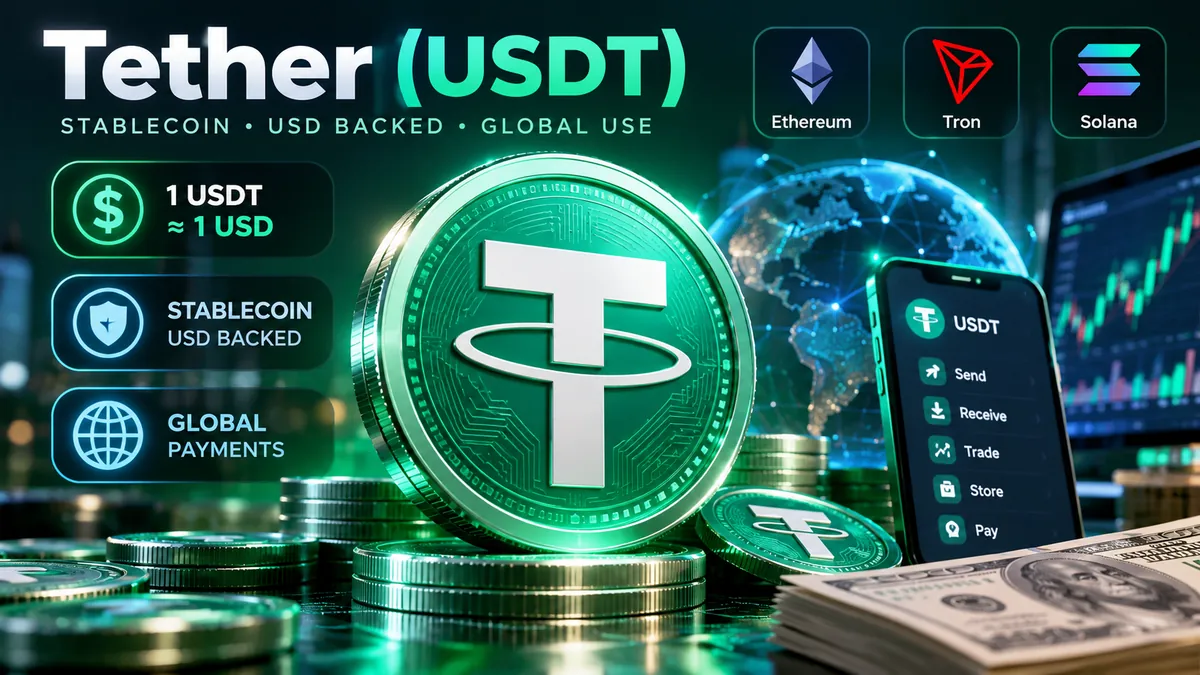
Tether is a company that issues digital tokens linked to traditional currencies. Its best-known product is USD₮, commonly written as USDT.
USDT is designed to maintain a one-to-one relationship with the US dollar.
In simple terms:
1 USDT is intended to equal 1 USD.
Unlike Bitcoin, which has no fixed dollar target, USDT is designed to provide a relatively stable unit of value for transactions in the cryptocurrency ecosystem.
Tether states that its circulating tokens are backed by reserve assets. Those reserves can include cash, cash equivalents, US Treasury securities, and other financial assets.
However, USDT is not the same as holding US dollars in a bank account. It is a digital token issued by a private company, with its own financial, operational, and regulatory risks.
How Does Tether (USDT) Work?
Tether operates through a combination of reserve assets, token issuance, redemption processes, and blockchain technology.
1. USDT Is Linked to the US Dollar
USDT targets a value of approximately $1 per token.
The goal is to make the token more predictable in dollar terms than cryptocurrencies such as Bitcoin or Ethereum.
This does not mean its exchange price can never move.
2. Tether Maintains Reserve Assets
According to Tether, issued tokens are supported by assets held in its reserves.
These assets are intended to support the token's value and the issuer's redemption obligations.
The quality, liquidity, valuation, and composition of reserves are important considerations for anyone evaluating a stablecoin.
3. Tokens Are Issued on Blockchains
USDT exists on multiple blockchain networks.
The tokens can be transferred between compatible wallets and services without moving physical cash.
Transactions are recorded according to the rules of the underlying blockchain.
4. Eligible Customers Can Redeem Tokens
Tether provides direct issuance and redemption services to eligible, verified customers under its terms.
Ordinary retail users typically obtain or sell USDT through cryptocurrency exchanges or other third-party services rather than redeeming directly with Tether.
Direct redemption has eligibility requirements, minimum amounts, and potentially applicable fees.
5. Market Trading Influences the Price
USDT is traded on exchanges, where supply and demand can move its price slightly above or below $1.
The reserve and redemption mechanisms are intended to support confidence in its dollar peg.
Nevertheless, a stablecoin's target price is not a guarantee.
Why Is Tether Called a Stablecoin?
A stablecoin is a cryptocurrency designed to maintain a relatively stable value compared with a reference asset.
USDT is a fiat-referenced stablecoin because it tracks the US dollar.
Other stablecoins may use different mechanisms, such as reserve-backed structures, crypto collateral, or algorithmic systems.
These designs have different risk profiles.
Tether's model relies on reserve assets and issuer-managed redemption arrangements rather than a promise that the open-market price can never change.
Is USDT Always Worth $1?
No.
Although USDT targets one US dollar, its trading price can fluctuate.
For example, buyers may temporarily pay slightly more than $1 when demand is unusually high.
During periods of market stress, sellers may accept less than $1.
These price differences can be temporary, but a larger or persistent deviation from the target is possible.
A dollar peg is an objective, not a guaranteed exchange price.
Users should distinguish between Tether's contractual redemption arrangements for eligible customers and the price available on a third-party exchange.
What Backs Tether USDT?
Tether says its issued tokens are fully backed by reserve assets.
According to its disclosures, the reserve portfolio can include cash and cash equivalents, US Treasury-related holdings, and other investments or receivables.
This distinction matters: reserve backing does not necessarily mean that every USDT is supported by a physical dollar held in a bank account.
Tether publishes information about token circulation and periodic reserve reports.
Its February 2026 market report, covering the fourth quarter of 2025, reported approximately $192.9 billion in total reserves and a USDT market capitalization of approximately $187.3 billion at the reporting period's end.
Those are historical company-reported figures, not live balances.
Readers should review the latest reserve disclosures and independent assurance reports when assessing Tether's financial position.
Which Blockchains Support USDT?
USDT is a multi-chain digital asset, meaning versions of the token exist on different blockchain networks.
Examples include Ethereum, Tron, and Solana.
USDT on Ethereum (ERC-20)
Ethereum-based USDT uses the ERC-20 token standard.
It can interact with compatible Ethereum wallets and applications.
Ethereum transaction fees depend on network conditions.
USDT on Tron (TRC-20)
Tron-based USDT uses the TRC-20 token standard.
It is commonly used for digital asset transfers and exchange transactions.
Fees and resource requirements depend on the network and wallet or service being used.
USDT on Solana
USDT also operates on Solana, which supports digital asset transfers and decentralized applications.
As with other networks, users must verify wallet and platform compatibility.
Why Choosing the Correct Network Matters
USDT on Ethereum and USDT on Tron are not interchangeable simply because they share the same ticker.
Sending tokens through an unsupported network can result in lost funds.
Before transferring USDT, verify the token, network, destination address, and receiving platform's deposit instructions.
Also note that Tether has discontinued direct issuance and redemption support on several legacy blockchains, including Omni, EOS, Algorand, Kusama, and Bitcoin Cash SLP.
Always check current network support before initiating a transfer.
What Is Tether Used For?
USDT has several common applications in digital finance.
Cryptocurrency Trading
Many cryptocurrency exchanges offer trading pairs denominated in USDT.
For example, a trader might exchange Bitcoin for USDT instead of converting the proceeds directly into a traditional bank currency.
This can simplify movement between different cryptocurrency positions.
However, holding USDT still carries issuer and platform risks.
International Transfers
USDT can be transferred across supported blockchain networks.
Some individuals and businesses use stablecoins for cross-border payments where legally permitted and where both parties accept the token.
The total cost depends on blockchain fees, exchange charges, and conversion costs.
Digital Payments
Merchants and service providers may accept USDT as payment.
Acceptance varies by country, provider, and applicable regulations.
Decentralized Finance
Some decentralized finance applications use USDT for lending, trading, and liquidity activities.
These uses introduce additional risks, including smart contract vulnerabilities, liquidation, and platform failures.
Holding Dollar-Referenced Value
Some users hold USDT because they want a digital asset designed to track the dollar rather than a cryptocurrency with large price swings.
However, USDT is not a bank deposit and should not automatically be treated as a risk-free cash equivalent.
Tether vs Bitcoin: What Is the Difference?
| Feature | Tether (USDT) | Bitcoin (BTC) |
|---|---|---|
| Main purpose | Dollar-referenced digital token | Decentralized digital asset |
| Price target | Approximately $1 | No fixed dollar peg |
| Issuer | Private company | No central issuing company |
| Supply model | Issuer-managed issuance and redemption | Protocol-defined issuance |
| Main risks | Issuer, reserves, peg, networks and platforms | Price volatility, custody, networks and platforms |
| Typical uses | Trading pairs, transfers and payments | Holding, transfers and payments |
USDT and Bitcoin serve different purposes.
Bitcoin is often discussed as a decentralized asset with a limited issuance schedule.
USDT is designed to offer a dollar-referenced unit of value within blockchain-based systems.
Neither is free from risk.
Tether vs USDC: What Is the Difference?
USDT and USDC are both US dollar-referenced stablecoins.
However, they are issued by different companies and operate under different reserve, redemption, transparency, and compliance arrangements.
| Feature | USDT | USDC |
|---|---|---|
| Issuer | Tether | Circle |
| Reference currency | US dollar | US dollar |
| Target value | $1 | $1 |
| Multiple blockchain networks | Yes | Yes |
| Reserve-backed structure | Yes | Yes |
| Risks | Issuer, reserve, redemption and network risks | Issuer, reserve, redemption and network risks |
When comparing stablecoins, review the latest issuer disclosures, redemption conditions, available networks, and regulatory requirements.
Is Tether (USDT) Safe?
USDT is widely used, but widespread adoption does not eliminate financial or technical risk.
1. Reserve Risk
The value and liquidity of Tether's reserve assets matter.
Changes in reserve quality, asset valuations, or market liquidity could affect confidence.
2. Depegging Risk
USDT can trade above or below its intended $1 value.
In severe circumstances, a stablecoin may experience a significant or sustained loss of its peg.
3. Issuer and Counterparty Risk
USDT depends on a private issuer and its operational and financial arrangements.
This differs from holding cash directly.
4. Exchange and Custody Risk
Keeping USDT on an exchange exposes users to the platform's security and financial risks.
Self-custody introduces responsibility for protecting wallet credentials and private keys.
5. Blockchain and Transfer Risk
Transactions can be irreversible.
An incorrect address, unsupported network, or compromised wallet may cause permanent loss.
6. Regulatory Risk
Stablecoin regulations vary across jurisdictions and can change.
Access to particular tokens, exchanges, or services may be restricted.
7. Fraud and Scam Risk
Fraudsters may create misleading tokens, impersonate legitimate services, or promise unrealistic returns.
Users should verify official token details and avoid suspicious links or payment requests.
How Can Beginners Use USDT More Carefully?
Anyone considering USDT should understand the technology and risks before transferring money.
A practical safety checklist includes:
1. Check whether USDT use is permitted in your jurisdiction.2. Choose a reputable and appropriately regulated service where available.3. Verify the exact token and supported blockchain network.4. Confirm the recipient address before sending.5. Consider a small test transfer when appropriate.6. Review transaction and withdrawal fees.7. Protect account credentials and wallet recovery information.8. Avoid guaranteed-profit claims and unsolicited investment offers.9. Review Tether's latest reserve and transparency disclosures.
These precautions can reduce certain risks, but they cannot eliminate them.
Is Tether a Good Investment?
USDT is primarily designed to track the US dollar, not to appreciate substantially in price.
Someone buying USDT at approximately $1 should not normally expect the token itself to rise dramatically in value.
USDT can be useful as a transfer or settlement asset, but it still exposes holders to financial and operational risks.
Products advertising unusually high returns on USDT generally involve additional lending, trading, platform, or smart contract risks.
A stable price target should not be confused with guaranteed safety or guaranteed returns.
What Is the Future of Tether in 2026?
Stablecoins are increasingly discussed as part of the broader digital payments and financial technology landscape.
Their potential applications include international settlement, digital commerce, tokenized financial services, and blockchain-based transfers.
Tether's future will depend on several factors:
- Demand for dollar-referenced digital assets
- Regulatory developments
- Reserve transparency and confidence
- Blockchain infrastructure
- Competition from other stablecoins
- Institutional and consumer adoption
Tether also announced a separate US-focused stablecoin initiative, USA₮, illustrating its interest in additional regulated-market products.
However, the success of any stablecoin depends on more than market size. Financial resilience, compliance, security, and user trust remain essential.
Frequently Asked Questions About Tether (USDT)
What does USDT stand for?
USDT is the commonly used ticker for Tether's US dollar-referenced stablecoin, USD₮.
Is Tether the same as the US dollar?
No. Tether USDT is a privately issued digital token designed to track the dollar. It is not physical cash or a conventional bank deposit.
Is 1 USDT always equal to $1?
No. USDT targets a one-dollar value, but its market price can fluctuate.
Who owns Tether?
Tether is issued by companies within the Tether group. It is not a decentralized cryptocurrency with no issuer.
Can USDT be transferred internationally?
USDT can be transferred on supported blockchain networks, subject to service availability, technical compatibility, and applicable laws.
Is USDT available on Ethereum and Tron?
Yes. USDT has versions on both Ethereum and Tron, but users must select the correct network when transferring funds.
Can I lose money holding USDT?
Yes. Potential losses can arise from depegging, issuer problems, exchange failures, fraud, wallet compromise, or transfer mistakes.
Does Tether pay interest?
Simply holding USDT does not inherently provide interest. Third-party products that offer returns introduce additional risks.
Is USDT legal?
Its legal status and the availability of related services depend on the country and applicable regulations.
What is the difference between Tether and USDT?
Tether generally refers to the company or brand, while USDT refers to its US dollar-referenced token.
Final Thoughts
Tether USDT plays an important role in the cryptocurrency ecosystem by providing a digital token designed to maintain a value close to the US dollar.
It is widely used for trading, transfers, payments, and blockchain-based financial activities.
But the word stablecoin should not be mistaken for a promise of complete safety.
USDT depends on reserve assets, issuer operations, redemption arrangements, blockchain networks, and market confidence.
For beginners, understanding those mechanisms is more important than simply knowing that one USDT is intended to equal one dollar.
As digital finance evolves, Tether remains a significant example of how traditional currency values can be represented and transferred through blockchain technology.
Official Sources and Further Reading
- [Tether — How It Works](https://tether.to/en/how-it-works/)- [Tether — Frequently Asked Questions](https://tether.to/en/faqs/)- [Tether — Transparency and Reserves](https://tether.to/en/transparency/)- [Tether — Terms of Service](https://tether.to/en/legal/)- [Tether — Q4 2025 USDT Market Report](https://tether.io/news/usdt-q4-2025-market-report/)- [Tether — Legacy Blockchain Support Update](https://tether.io/news/tether-provides-update-on-transition-plan-for-legacy-blockchains/)
Disclaimer: This article is for educational and informational purposes only. It does not constitute investment, legal, or financial advice. Cryptocurrency and stablecoin transactions involve risk, including the possible loss of funds. Product details and regulations may change.