Tesla Flying Roadster 2026: SpaceX Thrusters, Price and Release Date
Tesla's redesigned Roadster stunned viewers with an airborne demonstration using SpaceX-inspired thrusters. Here's what the prototype proved, what remains uncertain, and when buyers might get one.
In this article
- What Happened at the Tesla Roadster Reveal?
- How Does the Tesla Flying Roadster Work?
- Is the Tesla Roadster Really a Flying Car?
- Tesla Roadster Performance: What Has Been Announced?
- Three Roadster Versions: Performance, Thrust and Rocket
- How Much Will the Tesla Flying Roadster Cost?
- When Will the New Tesla Roadster Be Released?
- Can You Legally Drive a Thruster-Equipped Roadster on Public Roads?
- Why Tesla Is Building Such an Extreme Electric Car
- What the Roadster Demonstration Does Not Prove
- What Could This Mean for Future Electric Vehicles?
- Frequently Asked Questions
- Will the Roadster be allowed to fly on public roads?
- Final Thoughts
- Sources and Further Reading
Tesla has finally shown the world what Elon Musk meant when he suggested that a future Roadster might be able to fly.
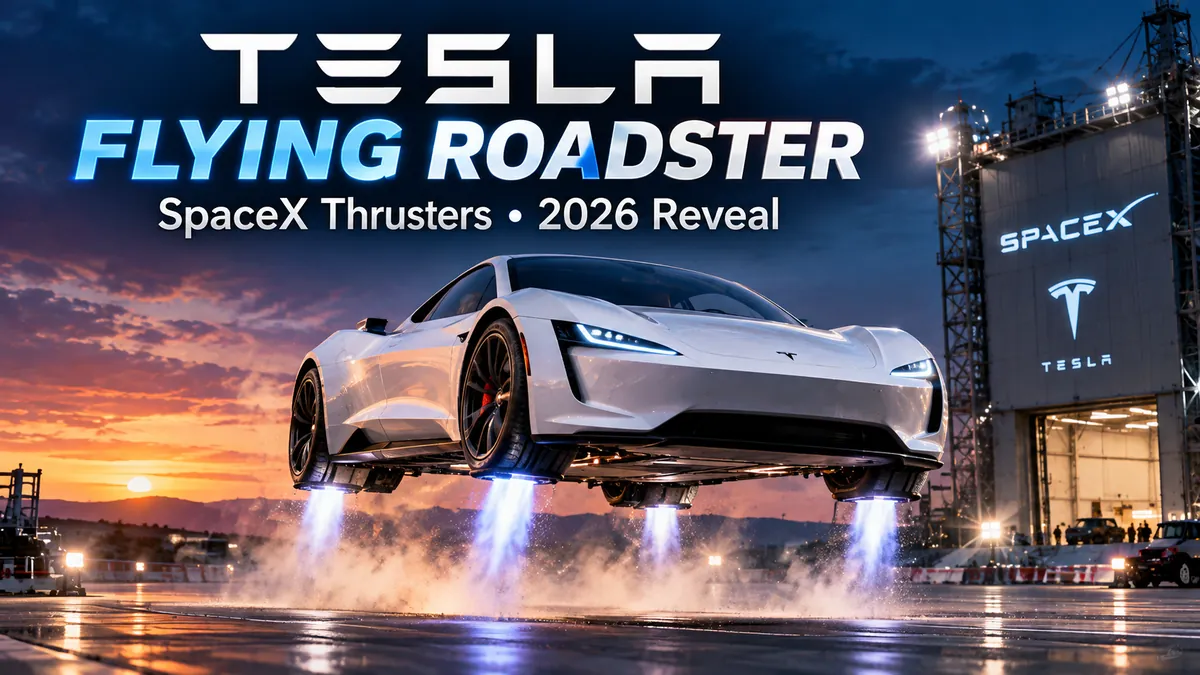
At an October 15, 2026 event at SpaceX's Texas testing facility, the company demonstrated a redesigned electric sports car capable of performing brief airborne maneuvers using a combination of specialized aerodynamic systems and compressed-gas thrusters.
The demonstration was striking, but it also raised a practical question: Is Tesla developing a genuine flying car, or an extraordinary high-performance road vehicle capable of controlled jumps?
The distinction matters for anyone considering the Roadster's capabilities, availability, or potential place in the future of transportation.
What Happened at the Tesla Roadster Reveal?
Tesla's long-awaited second-generation Roadster made its public debut in a dramatic demonstration involving a curved ramp, an inverted driving section, and a controlled airborne maneuver.
The vehicle traveled along a specially designed structure, used a suction system to maintain contact with the surface, and then transitioned into the air before rotating and landing on its wheels.
Tesla also demonstrated the Roadster moving over other vehicles with assistance from its thruster system.
The event represented a significant step beyond earlier promotional claims. Instead of relying entirely on computer-generated previews or future promises, Tesla showed a physical vehicle performing unusual maneuvers in a controlled environment.
However, the presentation did not establish that the Roadster can fly freely for extended distances, operate as an aircraft, or perform the same maneuvers safely on public roads.
Those are separate engineering and regulatory challenges.
How Does the Tesla Flying Roadster Work?
The most unusual element of the new Roadster is its use of cold-gas thrusters developed through collaboration between Tesla and SpaceX engineers.
Conventional electric vehicles rely on their motors to generate torque at the wheels. That force is transferred to the road through the tires.
Thrusters work differently. They expel compressed gas to generate force, potentially helping a vehicle accelerate, stabilize itself, or change its orientation.
According to details shared during the reveal, Tesla's advanced Roadster configuration uses multiple thrusters and onboard compressed-gas storage.
The demonstration also involved a suction system designed to increase the vehicle's ability to remain attached to a driving surface during extreme maneuvers.
These systems serve different purposes.
The suction system helps manage the vehicle's contact with the ground or a specially prepared surface. The thrusters provide forces that can assist with acceleration and limited movement through the air.
Together, they create capabilities that are far outside those of a conventional electric sports car.
Yet there is an important limitation: a short burst of airborne movement is not the same as sustained flight.
Is the Tesla Roadster Really a Flying Car?
That depends on how the term "flying car" is defined.
In the broadest sense, Tesla demonstrated a road vehicle capable of briefly leaving the ground and controlling its movement with thrusters.
In the conventional aviation sense, however, a flying car would need to operate safely and repeatedly through the air, navigate between locations, and meet applicable aviation requirements.
The Roadster demonstration did not establish those capabilities.
Unlike aircraft designed around wings, rotors, or dedicated vertical-lift systems, the Roadster remains fundamentally a performance-focused electric car.
Its airborne features appear intended for short-duration maneuvers rather than routine point-to-point flight.
That makes the new Roadster fascinating, but it would be premature to describe it as a replacement for helicopters, aircraft, or emerging electric vertical takeoff and landing vehicles.
Tesla Roadster Performance: What Has Been Announced?
Tesla has made ambitious performance claims for the redesigned Roadster.
During the 2026 reveal, the company discussed acceleration from 0 to 60 mph in less than one second for a thruster-equipped configuration.
Tesla also described a top speed exceeding 230 mph and an estimated driving range of approximately 300 miles.
These figures are extraordinary, even in a market where high-performance electric vehicles already deliver rapid acceleration.
However, they should be understood as manufacturer claims and demonstration figures rather than independently verified production specifications.
Real-world results will depend on the final vehicle's hardware, testing conditions, tire performance, safety systems, and regulatory restrictions.
The Roadster's estimated 300-mile range also differs substantially from the much higher range originally discussed when Tesla introduced its second-generation concept in 2017.
This change illustrates why specifications announced years before production should not be treated as guarantees.
Three Roadster Versions: Performance, Thrust and Rocket
Tesla has outlined three versions of the new Roadster, each with a different emphasis.
Performance
The Performance version is positioned as the more conventional road-oriented configuration. Tesla has described it as a two-seat electric sports car with advanced aerodynamics and specialized handling technology.
Thrust
The Thrust version adds acceleration-focused cold-gas thrusters. It is aimed at buyers seeking more extreme performance than the standard configuration.
Rocket
The Rocket version is the most ambitious variant. Tesla has described a single-seat configuration with a more extensive thruster system designed to support airborne maneuvers.
The Rocket version is presented as an invitation-only offering.
These descriptions reflect Tesla's announced plans. Final production specifications, approved capabilities, and availability could change before deliveries begin.
How Much Will the Tesla Flying Roadster Cost?
Tesla did not announce a complete final retail price list during the October 2026 event.
However, its reservation information provides some indication of the intended market.
Reports following the reveal described a $50,000 reservation deposit for the Performance version and a $250,000 deposit for the Thrust version.
The Rocket configuration is listed as invitation-only.
These amounts are reservation deposits, not confirmed final purchase prices.
That distinction is important. A customer should not assume that a reservation amount represents the total cost of the vehicle.
Tesla has previously discussed pricing for earlier versions of the Roadster, but those older figures should not automatically be applied to the redesigned 2026 model.
Prospective buyers should review Tesla's current reservation terms, payment conditions, and refund policies directly before making any financial commitment.
When Will the New Tesla Roadster Be Released?
Tesla currently targets 2028 for production of the redesigned Roadster.
That timeline comes after a long series of delays.
The second-generation Roadster was originally announced in 2017, with early expectations that deliveries would begin years earlier than the current schedule.
Since then, Tesla has concentrated resources on mass-market electric vehicles, manufacturing expansion, autonomous-driving technology, and robotics.
The latest demonstration shows meaningful progress, but it does not guarantee that production vehicles will reach customers on schedule.
For buyers, the distinction between a successful prototype demonstration and large-scale manufacturing remains essential.
Building a handful of highly specialized vehicles for controlled demonstrations is very different from producing, certifying, servicing, and delivering road-ready cars.
Can You Legally Drive a Thruster-Equipped Roadster on Public Roads?
This may be the most important unanswered question surrounding the vehicle.
Even if Tesla can reproduce the demonstration consistently, public-road use introduces significant safety and legal complications.
Thrusters generate forces that could affect nearby pedestrians, vehicles, road surfaces, and surrounding objects.
Airborne maneuvers also create questions about driver control, collision risks, emergency response, and vehicle certification.
Tesla has not established that the Roadster's full airborne capabilities will be approved for unrestricted use on ordinary streets.
Different jurisdictions could apply different rules, and some functions may ultimately be limited to controlled facilities or specialized environments.
A vehicle's ability to perform a maneuver during a demonstration does not mean a customer will legally be permitted to perform it on a public highway.
Why Tesla Is Building Such an Extreme Electric Car
From a commercial perspective, a thruster-equipped Roadster is unlikely to become a mass-market product.
Its potential importance lies elsewhere.
High-profile sports cars often function as technological showcases. They demonstrate engineering expertise, attract attention, and help define how the public perceives a brand.
Tesla's original Roadster helped challenge the assumption that electric vehicles had to be slow or unexciting.
The new Roadster appears designed to push that idea much further.
It also highlights a distinctive aspect of Tesla's engineering strategy: borrowing concepts from aerospace and applying them to automotive problems.
Whether the resulting technology will influence more affordable electric vehicles remains uncertain.
The immediate value of the Roadster may be less about sales volume and more about experimentation, brand identity, and technical ambition.
What the Roadster Demonstration Does Not Prove
The reveal offered a dramatic display of engineering, but several questions remain open.
First, the demonstration did not establish how frequently the thrusters can be used before the compressed-gas system needs replenishment.
Second, it did not provide independently verified data about long-term reliability, maintenance costs, or the performance of production-ready vehicles.
Third, the demonstration took place under controlled conditions. It does not establish how the same systems would perform in unpredictable traffic, adverse weather, or emergency situations.
Fourth, the full cost and regulatory status of the advanced configurations remain unresolved.
These questions do not erase the significance of what Tesla demonstrated. They simply separate an impressive prototype from a finished consumer product.
What Could This Mean for Future Electric Vehicles?
The Roadster introduces an interesting engineering question: Can technologies normally associated with aerospace improve the performance of ground vehicles?
Some ideas may have practical value beyond dramatic airborne stunts.
For example, innovations in lightweight pressure vessels, thermal management, vehicle control software, and high-performance aerodynamics could potentially influence future automotive designs.
But these are possible applications, not confirmed technology transfers to other Tesla models.
The biggest lesson may be that electric-vehicle innovation is not limited to battery capacity and motor efficiency.
Vehicle dynamics, materials science, software, and unconventional mechanical systems can also create new possibilities.
Whether those possibilities lead to useful consumer technology will depend on cost, reliability, and safety.
Frequently Asked Questions
Did Tesla actually demonstrate a flying car in 2026?
Tesla demonstrated a redesigned Roadster performing brief airborne maneuvers with thruster assistance at a controlled event in Texas on October 15, 2026. That is not equivalent to demonstrating sustained, unrestricted flight.
Does the Tesla Roadster use SpaceX technology?
Yes. Tesla has described a collaboration with SpaceX engineers involving cold-gas thrusters and related systems.
How fast is the new Tesla Roadster?
Tesla has claimed sub-one-second acceleration from 0 to 60 mph for a thruster-equipped version and a top speed above 230 mph. These should not be treated as independently verified final production figures.
What is the price of the Tesla Flying Roadster?
Tesla has not confirmed complete final retail pricing for the redesigned vehicle. Reported reservation deposits are not the same as purchase prices.
When can customers buy the new Roadster?
Tesla is targeting production in 2028. Actual delivery dates remain uncertain.
Will the Roadster be allowed to fly on public roads?
There is no confirmed general approval for public-road airborne maneuvers. Safety and regulatory questions remain unresolved.
Final Thoughts
Tesla's 2026 Roadster reveal is one of the most unusual electric-vehicle demonstrations in recent years.
The company has shown that a specially engineered sports car can use thrusters and aerodynamic systems to perform maneuvers that conventional road vehicles cannot.
That is a noteworthy achievement.
But there is still a substantial distance between an extraordinary demonstration and a practical, legally approved flying car.
The Roadster's next major test will not be another spectacular stunt. It will be whether Tesla can turn the prototype into a reliable production vehicle with clearly defined capabilities, realistic pricing, and an achievable delivery schedule.
Until then, the new Roadster is best understood as an ambitious electric performance car that briefly takes to the air—not yet the flying car of everyday science fiction.
Sources and Further Reading
Reuters — Tesla's new Roadster turns in air with SpaceX thrusters, won't land until 2028 https://www.reuters.com/business/autos-transportation/tesla-set-unveil-next-generation-roadster-sports-ev-after-years-delay-2026-10-15/
Associated Press — Tesla's new Roadster car can thrust itself in the air https://apnews.com/article/7d5f19665435b7408025bfb7a2f2f0b7
TechCrunch — Tesla reveals SpaceX-powered Roadster that flies and falls with style https://techcrunch.com/2026/10/15/tesla-reveals-spacex-powered-roadster-that-flies-and-falls-with-style/