Critical PHP Vulnerabilities in 2026: Two Security Flaws Put Websites at Risk
Two critical PHP vulnerabilities disclosed on October 21, 2026 could expose affected web servers to remote code execution. Here's what website owners need to know about the risks and security updates.
In this article
- What Happened to PHP in October 2026?
- Why Are These PHP Vulnerabilities Dangerous?
- CVE-2026-109618: Out-of-Memory Handling Vulnerability
- CVE-2026-109619: Stale State Between Requests
- Which PHP Versions Are Affected?
- Are WordPress and Other PHP Websites at Risk?
- What Should Website Owners Do Immediately?
- What About Shared Hosting?
- Could These Vulnerabilities Affect Website Availability?
- How Do the PHP Security Updates Work?
- How Artificial Intelligence Contributed to the Research
- What This Means for the Future of PHP Security
- Frequently Asked Questions
- Can AI help identify security vulnerabilities?
- Sources and References
Two critical security vulnerabilities in PHP have prompted urgent warnings from cybersecurity authorities and technology companies, raising concerns for website owners, hosting providers, and organizations that rely on the widely used server-side programming language.
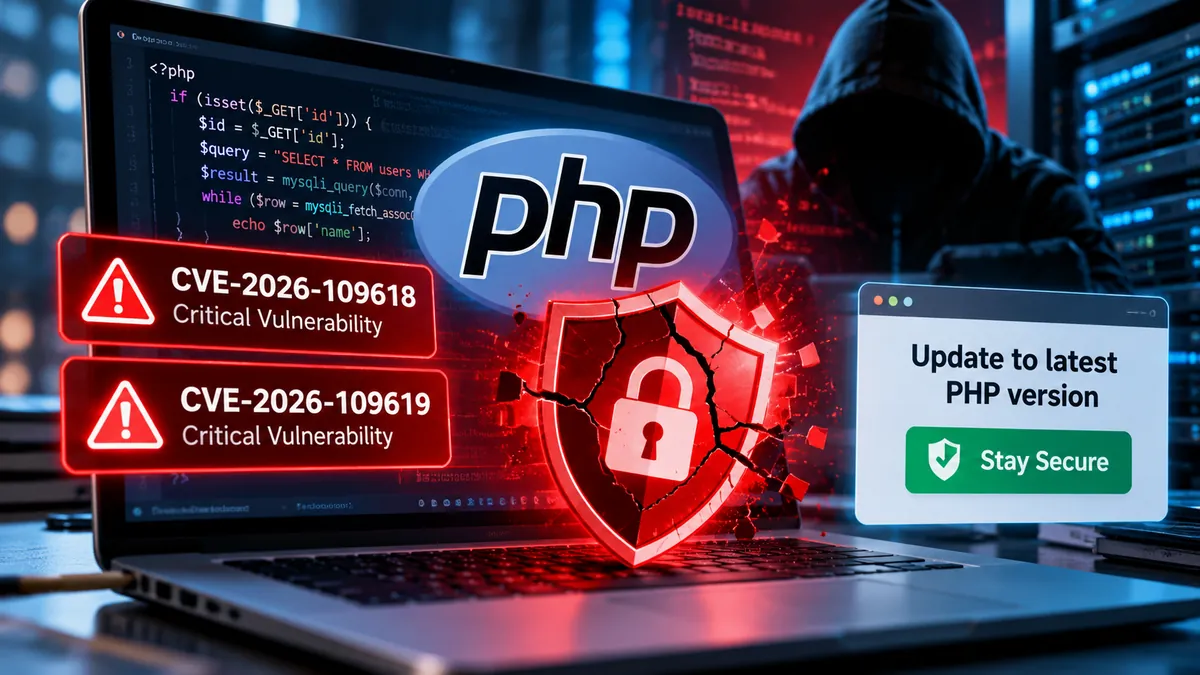
Disclosed on October 21, 2026, the vulnerabilities are tracked as CVE-2026-109618 and CVE-2026-109619. Both received a critical CVSS 4.0 severity score of 9.2 and could allow an unauthenticated attacker to execute malicious code on an affected server under certain conditions.
Security updates are now available for supported PHP branches. Organizations are being urged to identify vulnerable installations and apply the appropriate patches without delay.
For businesses running PHP-powered websites, the announcement is a reminder that maintaining a secure server environment requires more than keeping application code up to date.
What Happened to PHP in October 2026?
On October 21, 2026, PHP security maintainers and researchers disclosed two serious flaws affecting the PHP runtime itself.
Unlike vulnerabilities confined to a particular website plugin or content management system, these issues involve internal PHP memory and request-handling behavior.
This distinction matters because PHP is used across many different kinds of web applications, including custom-built websites, online stores, publishing platforms, and popular content management systems.
The vulnerabilities were assigned the following identifiers:
CVE-2026-109618 — Remote code execution through out-of-memory handling and memory corruption.
CVE-2026-109619 — Remote code execution involving stale internal state retained between requests.
Both vulnerabilities received a critical severity rating of 9.2 under CVSS version 4.0.
Google Cloud, national cybersecurity agencies, and software vendors have published guidance encouraging administrators to install the available security updates.
Why Are These PHP Vulnerabilities Dangerous?
PHP runs on web servers and processes requests before delivering dynamic content to visitors.
Depending on the application, it may interact with databases, authentication systems, uploaded files, and other sensitive resources.
A vulnerability in the PHP runtime can therefore create risks that extend beyond a single website feature.
The two newly disclosed issues involve memory safety problems that may arise when PHP handles abnormal conditions or reuses internal state.
Successful exploitation could allow an attacker to execute code without first authenticating to the affected application.
The possible consequences depend on the server's configuration and the permissions available to the compromised PHP process.
They may include unauthorized access to application data, modification of website files, service disruption, or further attempts to compromise connected systems.
A critical vulnerability does not mean every PHP website has already been attacked. It means that affected installations require urgent attention because the potential consequences are serious.
CVE-2026-109618: Out-of-Memory Handling Vulnerability
The first vulnerability, CVE-2026-109618, concerns the way PHP handles certain out-of-memory conditions during request processing.
An out-of-memory condition occurs when a process cannot obtain the memory required to complete an operation.
Normally, software should respond to such failures without leaving internal data in an unsafe state.
In this case, researchers found that an interrupted operation could leave certain internal structures incompletely initialized.
Subsequent cleanup behavior might then interact with invalid memory, creating the possibility of memory corruption.
Under exploitable conditions, that corruption could be used to achieve remote code execution.
The issue illustrates why error handling is an important part of software security. Even when a program is designed to stop after a failure, the process of stopping must itself be safe.
CVE-2026-109619: Stale State Between Requests
The second vulnerability, CVE-2026-109619, involves internal state that may remain accessible after the memory associated with a request has been released.
Web servers often use long-running processes to handle multiple requests efficiently.
This improves performance, but it also makes correct state management essential.
Information associated with one request must not remain accessible in an unsafe form when the process handles another request.
Researchers identified conditions in which PHP could retain references to memory that was no longer valid.
A later operation might interact with that stale state, potentially causing memory corruption and creating an opportunity for remote code execution.
The technical conditions differ from those of CVE-2026-109618, but both issues highlight the security importance of careful memory management within the runtime.
Which PHP Versions Are Affected?
According to Google Cloud's October 21 advisory, vulnerable upstream PHP versions include releases from PHP 5.4 through PHP 8.5.11.
The PHP project has published fixed releases for its supported branches.
The following versions contain the relevant security fixes:
PHP 8.2 — Update to 8.2.35 or a later fixed release.
PHP 8.3 — Update to 8.3.36 or a later fixed release.
PHP 8.4 — Update to 8.4.27 or a later fixed release.
PHP 8.5 — Update to 8.5.12 or a later fixed release.
These version numbers refer to the official PHP releases.
Some Linux distributions and hosting providers distribute security patches through their own package systems. In those environments, a vendor may backport fixes without changing the upstream version number in the same way.
Administrators should therefore verify the security status of their installed packages against the relevant vendor advisory.
PHP 8.1 and older branches are no longer supported by the upstream PHP project. Organizations using them should plan a migration to a supported release rather than assuming future upstream security fixes will be provided.
Are WordPress and Other PHP Websites at Risk?
Many widely used web platforms depend on PHP.
These include WordPress, Drupal, Joomla, and numerous custom-built applications.
Because the vulnerabilities affect the PHP runtime, installing the latest version of a website plugin or theme does not necessarily address the underlying problem.
A website may have updated application code while still running a vulnerable PHP installation.
The actual exposure depends on the runtime version, hosting environment, web server configuration, and any relevant vendor patches.
Website owners should check both their application software and the PHP environment provided by their hosting company.
For shared-hosting customers, the hosting provider may control the server-level PHP packages and security updates.
What Should Website Owners Do Immediately?
The most important response is to determine whether the website is running an affected PHP installation and ensure that the appropriate security update is applied.
A practical response involves several steps.
1. Identify the PHP Version
Check the PHP version displayed in the hosting control panel or application environment.
Do not assume that a recent website redesign means the underlying PHP runtime is current.
If the hosting interface does not show the exact version and patch level, request confirmation from the provider.
2. Confirm That the Security Fix Is Installed
Compare the installed PHP version with the fixed releases listed in the official security advisory.
For managed hosting or Linux distribution packages, ask the provider whether the relevant CVEs have been patched or backported.
The most important question is not simply whether the server runs PHP 8, but whether its specific runtime package contains the required security fixes.
3. Back Up the Website Before Major Changes
Before upgrading PHP or making significant server changes, create a reliable backup of website files and databases.
Store the backup in a location that is not dependent solely on the same hosting account.
A backup does not eliminate a vulnerability, but it can support recovery if an update reveals compatibility problems or if the website experiences an unrelated failure.
4. Test Application Compatibility
PHP upgrades can affect applications that depend on older language features or extensions.
Test important functions such as login, publishing, file uploads, contact forms, and database operations.
For business websites, testing should ideally occur in a staging environment before changes are applied to production.
However, compatibility testing should not become an excuse to leave a critical vulnerability unpatched indefinitely.
5. Review Security Logs
Website owners and administrators should examine relevant server and application logs for unusual activity.
Potential warning signs include repeated unexpected process crashes, unusual requests, unauthorized file changes, and unfamiliar administrative activity.
These indicators are not proof of exploitation on their own.
A normal server error can have many causes, and meaningful investigation requires considering the surrounding evidence.
If a compromise is suspected, administrators should preserve relevant logs and involve their hosting provider or a qualified incident-response professional.
6. Keep the Rest of the Website Updated
Updating PHP is the priority for these specific vulnerabilities.
Website owners should also maintain secure versions of their application frameworks, content management systems, plugins, and dependencies.
Strong authentication, restricted file permissions, reliable backups, and regular monitoring remain important parts of a broader security strategy.
None of those measures should be treated as a replacement for installing the PHP security patches.
What About Shared Hosting?
Shared hosting is common among small businesses, independent publishers, and website owners who do not manage their own servers.
In this environment, the hosting provider typically controls important parts of the underlying operating system and PHP runtime.
Customers may be able to select a PHP version through a control panel, but they may not have permission to install or update server packages directly.
Shared-hosting users should ask their provider three specific questions.
First, which PHP version and security patch level are currently active for the website?
Second, have CVE-2026-109618 and CVE-2026-109619 been addressed in the hosting environment?
Third, is any customer action required, such as selecting a newer supported PHP branch?
A hosting provider should be able to clarify whether the necessary security updates have been applied.
Website owners should avoid making unsupported assumptions based only on the version number displayed in a simplified control panel.
Could These Vulnerabilities Affect Website Availability?
Memory corruption and abnormal process behavior can potentially affect the stability of software.
In some circumstances, a vulnerable or unstable runtime may crash or terminate a request unexpectedly.
However, not every PHP error, server crash, or HTTP 503 response is evidence of an attack.
Temporary server errors can also result from resource limits, hosting maintenance, application bugs, database connectivity problems, or overloaded backend processes.
Administrators should investigate recurring errors through server logs and hosting diagnostics rather than automatically attributing them to the newly disclosed vulnerabilities.
The security announcement makes runtime patching urgent, but it does not establish the cause of unrelated website outages.
How Do the PHP Security Updates Work?
The available updates address the underlying runtime behavior responsible for the disclosed vulnerabilities.
Installing the corrected PHP packages is intended to prevent exploitation of the specific memory-safety issues described in the advisories.
For organizations using official PHP releases, the relevant fixed versions are PHP 8.2.35, 8.3.36, 8.4.27, and 8.5.12.
For organizations using vendor-managed environments, the exact update procedure may differ.
Some systems receive patches through operating system repositories, managed hosting platforms, or container image updates.
After updating, administrators should verify that the running PHP processes are using the corrected software.
In containerized environments, that may require rebuilding images and redeploying applications rather than simply changing a configuration file.
The correct procedure depends on the deployment platform.
How Artificial Intelligence Contributed to the Research
The October 2026 disclosure also highlights the growing role of artificial intelligence in cybersecurity research.
According to Google Cloud, Wiz researchers used a combination of AI models during the discovery and remediation process.
Google Cloud specifically credited Gemini 4 Argon with contributing to vulnerability discovery, exploit development, attack detection, and patch validation.
This does not mean AI independently secured the PHP ecosystem.
Security research still requires careful technical analysis, responsible disclosure, coordination with maintainers, and validation of fixes.
However, the case demonstrates how AI-assisted tools may help researchers investigate complex software behavior and identify problems that are difficult to detect through ordinary testing.
It also shows why the growing capabilities of AI security tools must be accompanied by responsible handling of sensitive vulnerability information.
What This Means for the Future of PHP Security
PHP remains an important part of the modern web.
Its widespread use means that vulnerabilities in the language runtime can have consequences across many unrelated websites and services.
The October 2026 disclosure is particularly significant because it concerns internal memory management rather than a flaw in one website's business logic.
For hosting companies, the incident reinforces the need for rapid security patch deployment and clear communication with customers.
For developers, it highlights the importance of monitoring upstream security announcements and maintaining supported runtime versions.
For website owners, it offers a practical reminder that server software is part of website security, even when the site itself appears to function normally.
Frequently Asked Questions
What are the critical PHP vulnerabilities discovered in October 2026?
Two vulnerabilities, CVE-2026-109618 and CVE-2026-109619, were publicly disclosed on October 21, 2026. They involve memory-safety problems in PHP and may allow remote code execution under exploitable conditions.
How serious are these vulnerabilities?
Both received critical CVSS 4.0 severity scores of 9.2. The potential impact includes unauthorized code execution on affected servers.
Which PHP versions fix the vulnerabilities?
The official fixed releases include PHP 8.2.35, 8.3.36, 8.4.27, and 8.5.12. Vendor-maintained packages may use their own backported patches.
Is every PHP website already compromised?
No. Affected software does not automatically mean a successful attack has occurred. Website owners should apply security updates and investigate any credible signs of compromise.
Does updating WordPress fix these PHP vulnerabilities?
Not necessarily. WordPress and PHP are separate software components. The PHP runtime must receive the appropriate security fix.
Can shared-hosting customers install the patches themselves?
That depends on the hosting provider. Some customers can select an updated PHP version, while others must rely on the provider to update server packages.
Should website owners disable PHP completely?
For most PHP-powered websites, disabling PHP would prevent the application from working. The appropriate response is to apply the security updates or follow qualified vendor guidance when immediate patching is not possible.
Can AI help identify security vulnerabilities?
AI-assisted tools can support software analysis and security research. Google Cloud reported that AI models contributed to the investigation and remediation of the October 2026 PHP vulnerabilities.
Final Thoughts
The disclosure of CVE-2026-109618 and CVE-2026-109619 is an important security event for organizations that depend on PHP.
Both vulnerabilities affect the runtime itself and carry critical severity ratings, making timely patching essential.
Website owners should confirm their active PHP version, verify that the relevant security fixes are installed, and work with hosting providers where server updates are centrally managed.
The broader lesson is straightforward: keeping website content and application code updated is important, but maintaining a secure underlying runtime is equally essential.
Sources and References
PHP — Supported Versions
https://www.php.net/supported-versions.php
Google Cloud — Responding to Core PHP Vulnerabilities CVE-2026-109618 and CVE-2026-109619 (October 21, 2026)
Ubuntu Security Notice — USN-8948-1: PHP Vulnerabilities (October 21, 2026)
https://ubuntu.com/security/notices/USN-8948-1
Canadian Centre for Cyber Security — Critical Vulnerabilities Impacting PHP (October 21, 2026)
UK National Cyber Security Centre — Critical Security Issue Affecting PHP
https://www.ncsc.gov.uk/news/critical-security-issue-affecting-php
Editorial Note: This article is based on publicly available security advisories as of October 22, 2026. Vulnerability assessments, exploitation reports, and vendor patch availability may change. Website administrators should consult their software and hosting providers for the latest guidance.