The digital landscape is shifting from centralized cloud computing toward a more distributed architecture. At the heart of this evolution lies Edge AI and IoT Integration, a combination that allows devices to not only collect data but also think, analyze, and act upon it instantly. As we move deeper into 2026, this synergy is becoming the backbone of smart cities, autonomous vehicles, and industrial automation.
By bringing artificial intelligence closer to the source of data—the “edge”—we eliminate the latency and bandwidth issues that have long plagued traditional IoT setups. This article explores the mechanics, benefits, and transformative potential of this technological powerhouse.
1. What is Edge AI and IoT Integration?
To understand this concept, we must first define its components. The Internet of Things (IoT) refers to the vast network of physical devices—sensors, cameras, and machines—connected to the internet. Edge AI, on the other hand, refers to running machine learning algorithms directly on these local devices rather than on a distant cloud server.
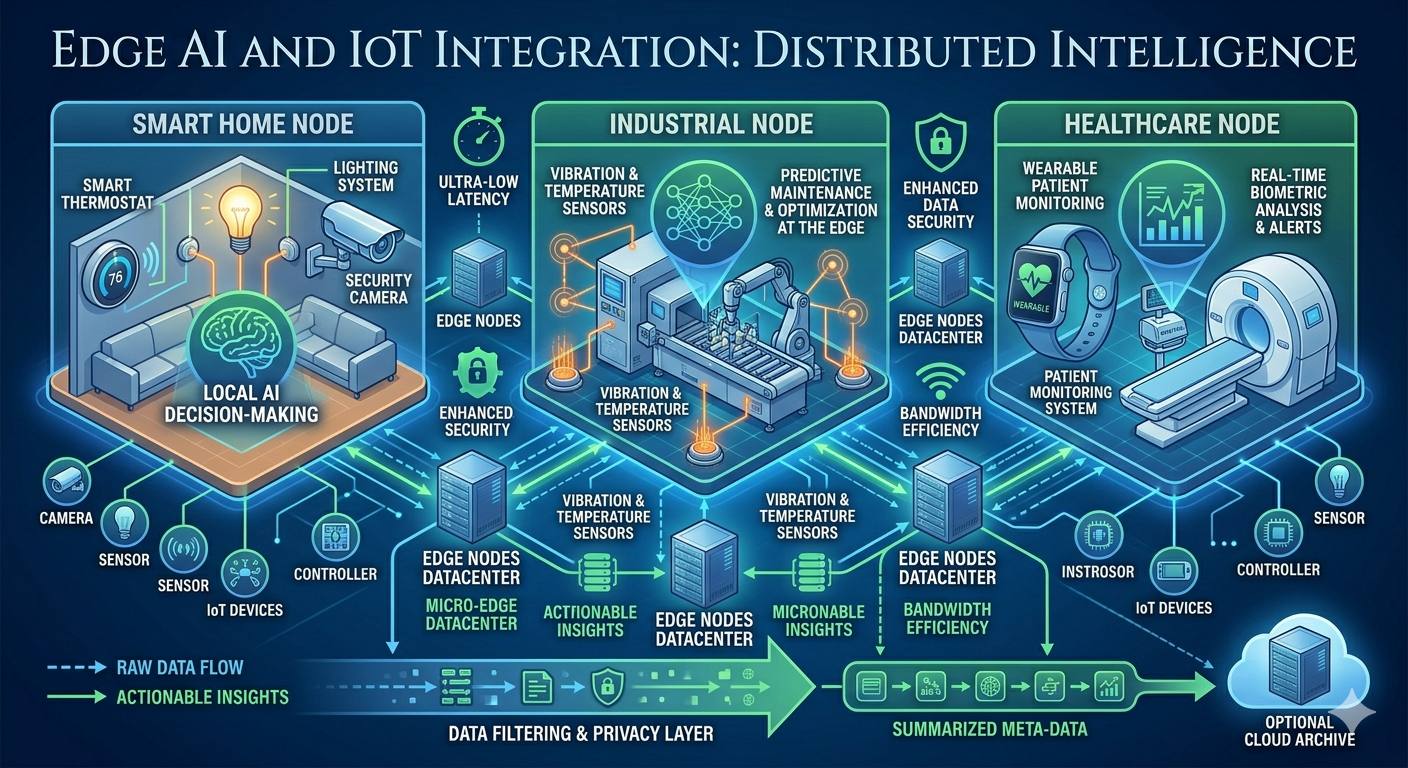
Edge AI and IoT Integration is the fusion of these two fields. Instead of a sensor simply sending raw data to a server in another country, the device itself processes the information. Whether it’s a security camera identifying a face or a factory sensor detecting a mechanical failure, the “intelligence” happens right where the action is.
2. The Shift from Cloud to Edge
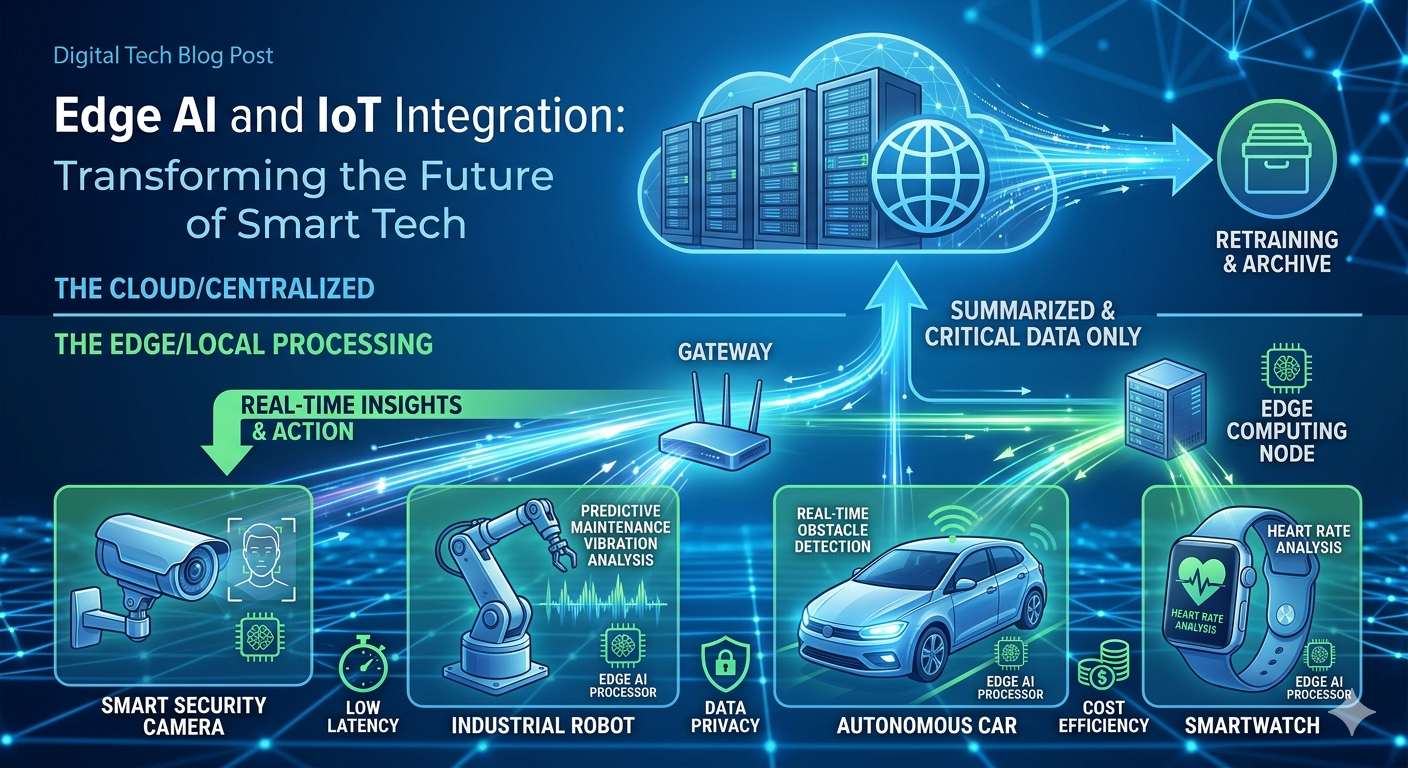
For years, the standard model was “Cloud-First.” IoT devices acted as “dumb” terminals that funneled data to the cloud for heavy lifting. However, the explosion of data has made this model unsustainable for several reasons:
- Latency: Sending data to the cloud and waiting for a response takes milliseconds that some applications (like self-driving cars) simply don’t have.
- Bandwidth: Streaming high-definition video or massive industrial logs 24/7 consumes immense network resources.
- Connectivity Dependency: Cloud-based systems fail if the internet connection is lost.
Through Edge AI and IoT Integration, devices gain autonomy. They can function offline and make split-second decisions without needing a constant handshake with a central server.
3. How Edge AI and IoT Integration Works
The architecture of a modern integrated system consists of three primary layers:
The Perception Layer (The Sensors)
This is where the IoT devices live. They gather environmental data such as temperature, vibration, sound, or visual frames.
The Edge Processing Layer (The Brain)
Equipped with specialized AI chips (NPUs or TPUs), the device runs a compressed machine learning model. This model is trained in the cloud but “executed” (inference) at the edge.
The Cloud Layer (The Archive)
The cloud is not eliminated; it is repurposed. It handles long-term storage, complex model retraining, and global data visualization. Only “important” data or summaries are sent here, reducing traffic by up to 90%.
4. Key Benefits of Integrating AI with the Edge
The adoption of Edge AI and IoT Integration offers several game-changing advantages for businesses and consumers:
Real-Time Processing and Low Latency
In critical applications like robotic surgery or autonomous drones, latency is a matter of life and death. Processing data at the edge ensures near-zero delay.
Enhanced Data Privacy and Security
One of the biggest concerns with IoT is the vulnerability of data in transit. By keeping data on the device, sensitive information—like private conversations or biometric data—never leaves the local network, significantly reducing the attack surface.
Cost Efficiency
Sending petabytes of data to cloud providers like AWS or Azure is expensive. By filtering data at the source, companies save significantly on storage and transmission costs.
Reliability in Low-Connectivity Areas
Remote mines, offshore oil rigs, and rural farms often have poor internet. Integrated systems ensure that AI-driven monitoring continues even in total isolation.
5. Real-World Applications in 2026
Smart Manufacturing (Industry 4.0)
In modern factories, Edge AI and IoT Integration powers “predictive maintenance.” Sensors on a robotic arm can hear a slight change in motor frequency—unnoticeable to humans—and shut down the machine before a costly break occurs.
Autonomous Vehicles and Drones
A self-driving car generates nearly 4 terabytes of data every day. It is impossible to send this to the cloud for real-time navigation. Edge AI allows the car to detect pedestrians and obstacles in real-time, ensuring safety.
Smart Retail and Healthcare
In retail, AI-enabled cameras track foot traffic and inventory levels locally. In healthcare, wearable devices can detect early signs of a heart attack or seizure and alert emergency services instantly, processing the pulse data on the watch itself.
Smart Cities and Traffic Management
Traffic lights equipped with Edge AI can analyze vehicle flow at an intersection and adjust timings dynamically to reduce congestion, all without needing a central command center.
6. Challenges and Technical Hurdles
Despite the benefits, implementing Edge AI and IoT Integration is not without obstacles:
- Hardware Constraints: Edge devices have limited power, memory, and cooling. Designing AI models that are small enough to run on a tiny chip without losing accuracy is a major engineering feat.
- Model Optimization: Engineers must use techniques like “Quantization” and “Pruning” to shrink massive neural networks.
- Device Management: Managing and updating thousands of smart devices across different locations requires robust “MLOps” (Machine Learning Operations) frameworks.
7. The Future: Towards a “Hyper-Connected” World
The future of Edge AI and IoT Integration lies in Colaborative Intelligence. In this scenario, devices will not only process data individually but will share insights with each other locally (Swarm Intelligence).
By 2030, we expect the emergence of “TinyML,” where even the smallest sensors—powered by ambient light or vibrations—will have basic AI capabilities. This will lead to a world where intelligence is truly invisible and ubiquitous.
8. Conclusion: Why It Matters Now
Edge AI and IoT Integration is more than just a tech trend; it is a fundamental requirement for the next generation of digital infrastructure. It addresses the core limitations of the cloud while unlocking new levels of speed, privacy, and efficiency.
As we continue to connect billions of devices to the internet, the only way to manage the resulting data deluge is to make the devices themselves smarter. Embracing this integration today is the key to staying competitive in a world where speed and intelligence are the ultimate currencies.