
1. The Great Workplace Reconfiguration
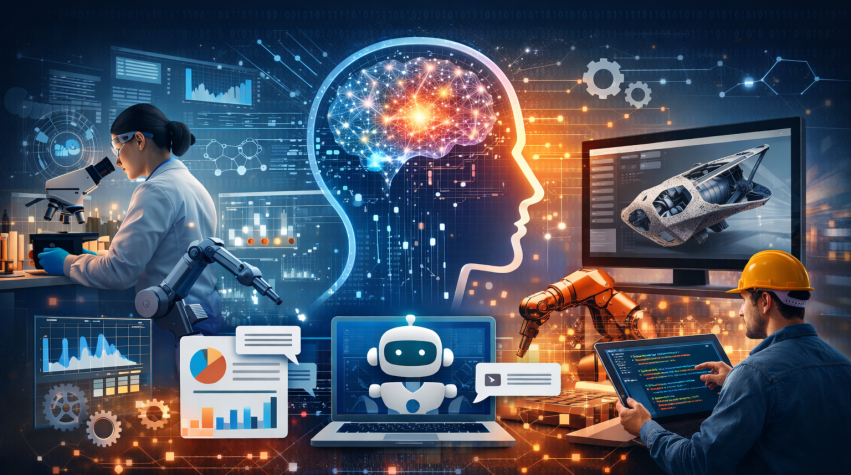
The binary debate of “Humans vs. Machines” has finally reached its expiration date. For years, the narrative was dominated by fear—the idea that silicon would eventually replace carbon-based workers in every sector. However, the reality on the ground has taken a much more sophisticated turn. We are witnessing the rise of Human-AI hybrid teams, a model where the goal is not replacement, but radical augmentation.
This shift isn’t just about using better software. It’s about a fundamental change in organizational psychology. In this model, artificial intelligence handles the “heavy lifting” of data processing and pattern recognition, while humans focus on high-stakes decision-making, ethical oversight, and creative nuance.
2. Defining the “Centaur” Workflow
In the world of professional chess, a “Centaur” is a player who combines their own intuition with the brute-force calculative power of a computer. This concept has now bled into the corporate world. Human-AI hybrid teams operate on this exact principle.
The Division of Labor
To understand why this works, we have to look at the cognitive strengths of both parties:
- The AI Component: Excels at “System 1” tasks—sorting through millions of spreadsheets, identifying anomalies in code, or generating a thousand variations of a marketing headline in seconds.
- The Human Component: Excels at “System 2” tasks—understanding the cultural context of a joke, navigating a sensitive HR crisis, or knowing when a data-driven prediction feels “off” due to real-world variables the machine hasn’t seen yet.
3. The Impact on Creative Industries
Perhaps nowhere is the influence of Human-AI hybrid teams more visible than in design and content creation. Tools like Adobe Firefly or Midjourney haven’t fired designers; they have turned them into Art Directors.
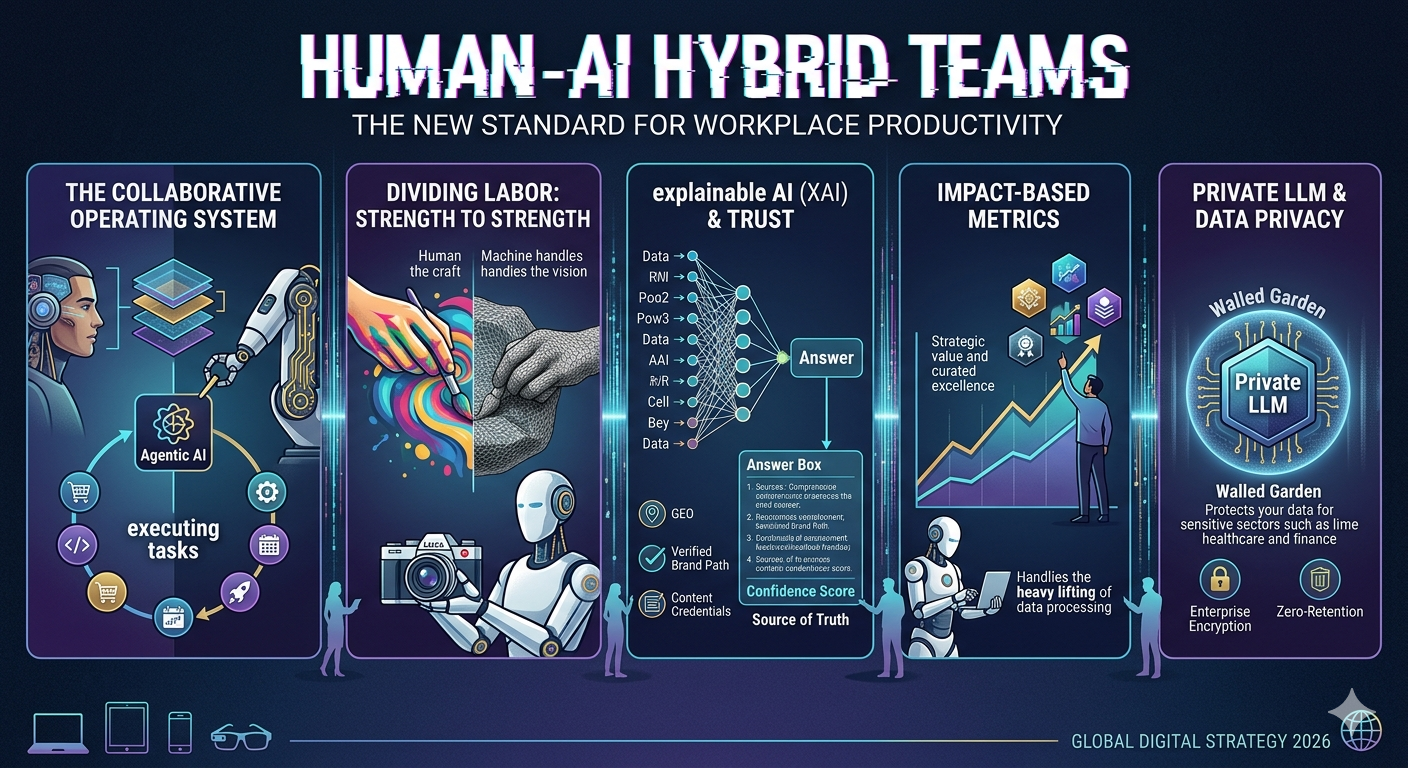
Instead of spending eight hours masking an image or adjusting lighting, a designer in a hybrid team spends thirty minutes prompting and refining, then four hours on the high-level conceptual strategy. The result is a 10x increase in output without a decrease in artistic integrity. This is the hallmark of a successful hybrid integration: the machine handles the craft, while the human handles the vision.
4. Technical Implementation and the “Trust Gap”
One of the biggest hurdles in establishing Human-AI hybrid teams is the “Trust Gap.” If a team doesn’t trust the output of their AI agent, they spend more time double-checking its work than they would have spent doing the task manually.
Building Explorable AI
To bridge this gap, organizations are moving toward “Explainable AI” (XAI). In a hybrid team, the AI doesn’t just give a “Yes” or “No” answer. It provides a confidence score and a list of the data points it used to reach that conclusion. This transparency allows the human partner to intervene only when the confidence score drops below a certain threshold, creating a seamless feedback loop.
5. Managing the Hybrid Workforce: A New Leadership Model
Managers who are used to overseeing purely human teams are finding themselves ill-equipped for this new era. Leading Human-AI hybrid teams requires a blend of traditional emotional intelligence and technical literacy.
- Prompt Engineering as a Core Skill: In the past, a manager needed to be good at giving “feedback.” Today, they need to be good at “prompting.” The ability to articulate a goal with enough precision that an AI can execute the first 80% is becoming a non-negotiable skill.
- Ethical Guardrails: The human manager acts as the “Ethical Sovereign.” They are responsible for ensuring that the biases inherent in AI training data don’t seep into the final product or service.
6. Productivity Metrics in the Hybrid Era
Traditional KPIs (Key Performance Indicators) are failing. If an employee uses an AI agent to complete a week’s worth of reports in two hours, should they be rewarded for efficiency or penalized for “working less”?
Forward-thinking companies are shifting toward Impact-Based Metrics. We no longer care how many hours were spent at a desk. We care about the quality of the insights and the strategic value of the output. In Human-AI hybrid teams, the “human” value is measured by their ability to guide the machine toward more valuable results, not by their manual labor.
7. The Socio-Economic Ripple Effect
The widespread adoption of Human-AI hybrid teams is causing a re-evaluation of the university degree. As technical skills (like basic coding or graphic production) become commoditized by AI, “soft skills” are becoming hard currency.
Philosophy, ethics, and sociology are no longer “useless” degrees. They are the foundations of the oversight needed to run an AI-heavy economy. We are seeing a “Renaissance” of the liberal arts, as these disciplines provide the critical thinking required to manage a synthetic workforce.
8. Security and Proprietary Data in Hybrid Ecosystems
A major concern for Human-AI hybrid teams is the protection of company secrets. If a team feeds their trade secrets into a public AI model, that data is gone.
The solution in 2026 has been the rise of “Private LLMs.” These are locally hosted or “zero-retention” models that allow a team to work with their most sensitive data without the risk of it being used to train the next version of a public bot. This “walled garden” approach is what has allowed the finance and healthcare sectors to finally join the hybrid revolution.
9. Case Study: The Hybrid Marketing Agency
Let’s look at a modern marketing firm. In a traditional setup, you had 50 people doing research, copy, and design. In a Human-AI hybrid teams setup, you have 10 people.
- The AI: Scrapes 24/7 for trending sentiments and generates 500 ad variations.
- The Humans: Select the top 5 variations that align with the brand’s soul, navigate the legal requirements of the specific region, and handle the high-level relationship with the client. The agency’s overhead is lower, but their billable value is higher because they are providing “curated excellence” rather than “mass-produced noise.”
10. The Future: Agentic Autonomy
As we move further into the decade, Human-AI hybrid teams will move toward “Agentic Autonomy.” This means the AI won’t wait for a prompt. It will observe the human’s workflow and proactively suggest improvements or start tasks before it is even asked.
The relationship will evolve from “User and Tool” to “Partner and Partner.” This requires a level of digital literacy that goes beyond knowing how to use an app—it requires an understanding of the underlying logic of the machine.
11. Conclusion: Embracing the Synthetic Partner
The transition to Human-AI hybrid teams is the most significant change in labor since the Industrial Revolution. It challenges our ego and our traditional definitions of work. However, those who embrace the “Centaur” model find themselves capable of feats that were previously impossible.
The future belongs to the hybrids. By combining the cold, relentless speed of silicon with the warm, unpredictable spark of human creativity, we are entering an era of unprecedented potential.
1 thought on “Human-AI Hybrid Teams”