

The world of Artificial Intelligence is undergoing a massive paradigm shift. The “Chatbot” era, which began with the explosion of ChatGPT in late 2022, is evolving into something far more sophisticated, independent, and powerful: Agentic AI. If you are running an AI directory or a tech-focused website, understanding Agentic AI is no longer optional—it is a necessity.
In this comprehensive guide, we will explore what Agentic AI is, its technical architecture, how it differs from Large Language Models (LLMs), and how it is set to redefine the digital landscape in 2026.
1. What is Agentic AI? Definition and Core Concept
Agentic AI refers to artificial intelligence systems that can think, plan, and act autonomously to achieve a specific goal. Unlike traditional AI, which requires step-by-step instructions, an AI Agent is goal-oriented.
To understand the difference, consider these two scenarios:
- Passive AI (Traditional): You ask, “Write a professional email to a client.” The AI writes the text and waits for your next command.
- Agentic AI: You say, “Analyze our Q1 sales data, find the top three underperforming regions, and send a personalized strategy proposal to the respective managers.”
In the second scenario, the AI doesn’t just write text. It accesses your database, performs calculations, creates a strategy, and executes the action by sending the emails. Agentic AI is the transition from AI as an “advisor” to AI as an “executor.”
2. Agentic AI vs. Traditional Chatbots: The Key Differences
For high SEO rankings, it’s crucial to categorize these differences. Here is a breakdown of why Agents are superior to standard LLM interfaces:
| Feature | Traditional AI (Chatbot) | Agentic AI (Agent) |
| Operational Mode | Reactive (Waits for prompts) | Proactive (Takes initiative) |
| Autonomy | Low (Needs constant human input) | High (Operates independently) |
| Tool Usage | Limited (Text/Image generation) | Extensive (Browser, APIs, Code, Files) |
| Memory | Short-term (Session-based) | Long-term (Persistent learning) |
| Error Handling | Requires human correction | Self-Correction (Iterative loops) |
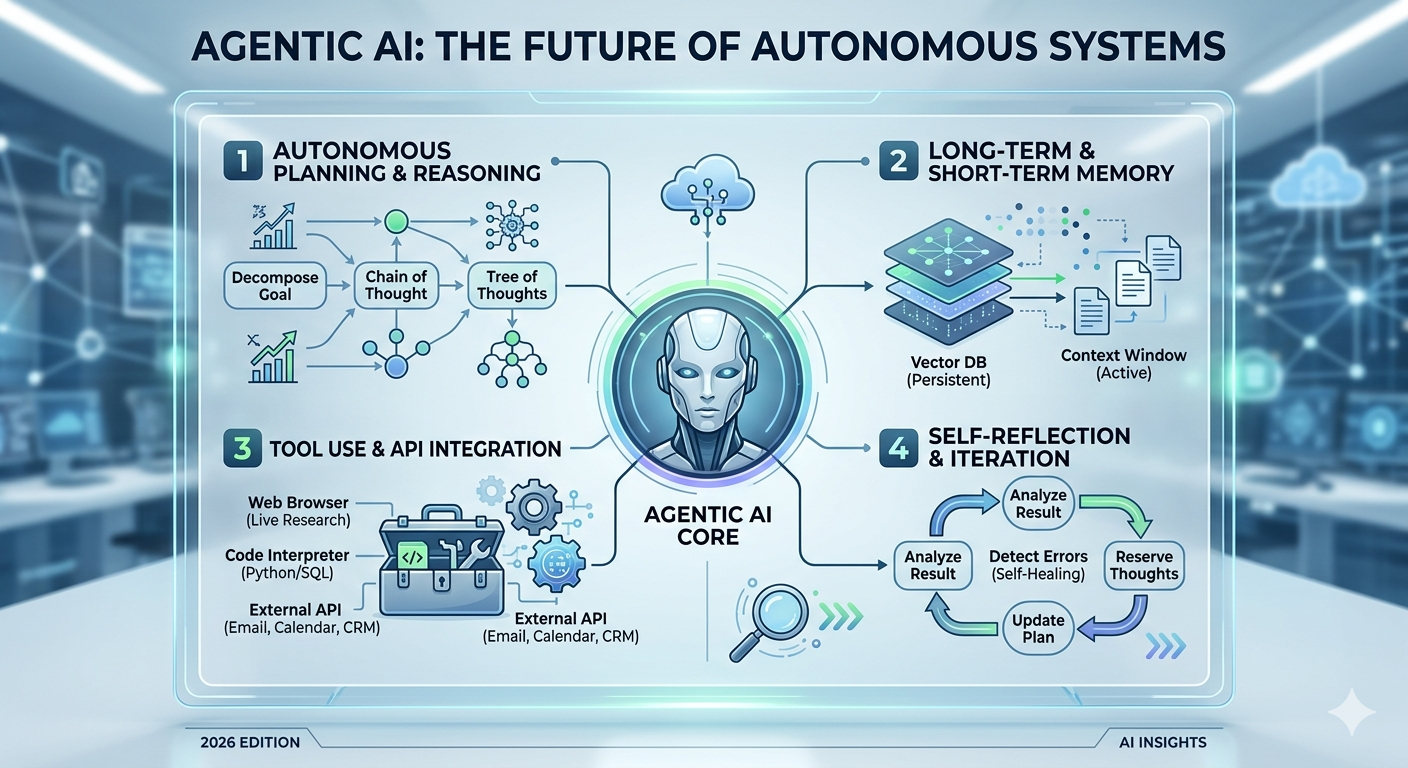
3. The Technical Architecture: The Four Pillars of an AI Agent
How does an AI Agent “think”? Unlike a simple script, an Agentic system relies on a complex cognitive loop.
A. Planning (The Brain)
The Agent breaks down a complex request into smaller, manageable sub-tasks. It uses methodologies like Chain of Thought (CoT) and Tree of Thoughts (ToT) to deliberate on the best path forward. If one path fails, the Agent re-evaluates and chooses an alternative.
B. Memory (The Context)
- Short-term Memory: Leverages the context window of the model to keep track of the current task.
- Long-term Memory: Utilizes Vector Databases (like Pinecone or Milvus) to store and retrieve past experiences, user preferences, and historical data.
C. Tools (The Hands)
This is what makes an Agent “Agentic.” Agents are equipped with a “Toolbox” that allows them to interact with the world:
- Web Browsers: To conduct real-time research.
- Code Interpreters: To write and execute Python/SQL code for data analysis.
- API Integrations: To connect with Slack, Google Calendar, Salesforce, or GitHub.
D. Reflection (The Quality Control)
Agents use “Self-Correction” loops. After completing a task, the Agent reviews its own work against the original goal. If the output is unsatisfactory, it restarts the process—mimicking human critical thinking.
4. Top Use Cases for Agentic AI in 2026
Software Engineering & Web Development
The days of simple code snippets are over. Agents like Cursor and Devin can now manage entire repositories. They can read your codebase, plan a new feature, write the code, run tests, and even handle the deployment to cloud servers.
Autonomous Marketing & SEO
An SEO Agent can monitor your competitors 24/7, identify trending keywords, and automatically update your blog posts to maintain high rankings. It functions as a full-time marketing department that never sleeps.
Personal Productivity Agents
Imagine an AI that knows your schedule, your budget, and your tastes. It can book flights, negotiate with customer service on your behalf, and manage your daily administrative tasks without you ever opening a browser tab.
5. Popular Frameworks and Tools for 2026
If you are looking to feature the best tools on your AI site, these are the industry leaders:
- CrewAI: The gold standard for multi-agent systems. It allows different AI agents (e.g., a “Researcher” and a “Writer”) to collaborate on a single project.
- Microsoft AutoGen: A powerful framework for building multi-agent workflows that can handle complex dialogue-based tasks.
- LangChain (LangGraph): The most flexible library for building stateful, multi-actor applications with AI.
- OpenAI Operator: A revolutionary agent that can control a computer screen just like a human, navigating websites and apps autonomously.
6. Security and Ethical Considerations: The “Alignment” Challenge
With great power comes great responsibility. The autonomy of Agentic AI brings several risks:
- The Alignment Problem: Ensuring the Agent’s goals remain aligned with human values.
- Hallucination Risks: If an Agent acts on a “hallucinated” fact (e.g., making a wrong financial transaction), the consequences are real.
- Privacy: Agents require deep access to personal or corporate data to be effective, raising significant cybersecurity concerns.
7. SEO Strategy: How to Optimize This Article (Rank Math Tips)
To ensure this article ranks #1 on Google, follow these technical SEO steps:
- Focus Keyword: “Agentic AI”, “What are AI Agents”.
- LSI Keywords: Autonomous AI, AI Agents 2026, LLM Reasoning, Multi-agent systems, AI automation.
- Meta Description: Explore the world of Agentic AI. Learn how autonomous AI agents work, the best tools in 2026, and how they are transforming the future of work.
- URL Slug:
yourdomain.com/what-is-agentic-ai-guide - Internal Linking: Link to your other AI tool reviews or “What is an LLM” articles.
- Visuals: Add diagrams showing the “Plan -> Act -> Reflect” loop to increase user dwell time.
Conclusion
Agentic AI is not just another buzzword; it is the operating system of the future. We are moving from a world where we “use” AI to a world where we “delegate” to AI. For developers, entrepreneurs, and everyday users, the ability to build and manage these agents will be the most valuable skill of the next decade.
As the AI landscape continues to evolve, staying updated with Agentic systems is the only way to remain competitive. The revolution is here—and it’s autonomous.